A lot of riders assume they’re protected when they’re not. That’s the short version of what we see at DRH Insurance Group, and it’s the reason we wrote this. Weekends on Texas trails, open fields, and backroads are how plenty of DFW families spend their free time. The ATV is a real investment of money and memories. But too many people carry coverage that leaves surprising gaps, or they carry no coverage at all and don’t know it.
We’re not here to talk anyone off their four-wheeler. We love that our neighbors get out and ride. We just want you to understand how ATV coverage actually works so you can make informed choices before you ever need to file a claim. What follows is a walk through the most frequent coverage missteps we run into, with local examples and plain explanations. The point is to help you avoid the common ATV insurance mistakes DFW riders make without burying you in jargon.
Why the common ATV insurance mistakes DFW riders make cost so much
These mistakes matter because an ATV sits in an awkward spot. It’s a vehicle, but it isn’t a car. It lives in your garage next to the lawnmower, but it isn’t a household item like your sofa. Because of that in-between status, people assume one of their existing policies quietly covers the machine. Usually it doesn’t.
When something goes wrong with an ATV, the dollar amounts climb fast. A rollover can total a machine. A trail collision can injure another rider. A theft out of an open garage can wipe out thousands of dollars of equipment overnight. Pair those costs with a coverage gap and riders end up paying out of pocket for things they assumed were handled.
Understanding the common ATV insurance mistakes DFW riders make really comes down to understanding where your protection stops. Let’s go through them one at a time so you can spot gaps in your own setup and bring sharper questions to a conversation with an agent.
Mistake 1: Assuming homeowners or auto insurance already covers your ATV
This is the single most common assumption we hear, and it’s the one that burns people most often. A rider buys an ATV, parks it in the garage, and figures it’s now part of the household the way a bicycle or a riding mower would be. It feels logical. It usually doesn’t hold up.
Homeowners insurance typically gives you very limited coverage for an ATV, and that coverage is often restricted to liability while you’re on your own property. So if something happens in your own yard, there may be some protection. The moment you load the ATV onto a trailer and head to a trail, a riding park, or a friend’s acreage, that limited homeowners protection generally stays home. Off-property use is exactly where most ATV accidents happen, which is what makes this gap so risky.
Auto insurance doesn’t fill it either. Your auto policy is built around licensed, road-going vehicles. An ATV isn’t one, so your car insurance almost never reaches it. Riders sometimes figure that because they pay for solid auto coverage, the quad gets folded in somehow. It doesn’t.
Picture a rider from Grand Prairie who takes the family ATV out to a trail for the afternoon. A spill injures a passenger and bends the frame. The homeowners policy doesn’t reach off-property use, and the auto policy never applied in the first place. That rider could be staring at the full cost of repairs and medical bills with no policy behind them.
This is the root of so many of the common ATV insurance mistakes DFW riders make. If you take one thing from this article, take this: don’t assume. Ask specifically how, when, and where your ATV is covered, because the honest answer under a standard home or auto policy is often “barely” or “not at all.”
Mistake 2: Skimping on liability coverage
Once riders realize they need a dedicated ATV policy, the next slip is treating liability as a box to check at the lowest level possible. Liability is the part of a policy that responds when you’re responsible for injuring someone else or damaging their property. It’s easy to glance at a minimum figure, decide it feels like plenty, and move on.
The problem is that ATV accidents can cause serious injuries. A collision with another rider, a passenger thrown during a rollover, or damage to someone else’s truck or fence can rack up medical bills, lost wages, and repair costs in a hurry. If those costs run past your liability limits, the difference doesn’t vanish. You can be personally on the hook for it, which means your savings and other assets are exposed.
We often ask riders to think about liability in terms of what a worst-case day could actually cost, not in terms of the cheapest option. Imagine an accident on a public trail near Grand Prairie that sends another person to the hospital. Thin liability limits could turn a bad afternoon into a long-term money problem. Carrying liability that reflects the real risk is one of the clearest ways to dodge the expensive side of the common ATV insurance mistakes DFW riders make.
How to think about liability limits without the stress
You don’t need to become an insurance expert to make a reasonable call here. Consider two things: how and where you ride, and what you’d want protected if a serious accident were your fault. The more public your riding areas and the more passengers involved, the more it usually makes sense to talk through higher liability options with an agent instead of defaulting to the floor.
Mistake 3: Skipping collision and comprehensive coverage
Liability protects other people. It does nothing for your own machine. That’s the job of collision and comprehensive coverage, and skipping them is another item on our list of common ATV insurance mistakes DFW riders make.
Collision coverage helps pay to repair or replace your ATV when it’s damaged in an accident. That covers hitting another vehicle, slamming into a tree or rock, or rolling the machine on uneven ground. Anyone who’s ridden Texas trails knows how fast a routine ride becomes a hard landing, and collision coverage is what sits between you and the full repair bill in those moments.
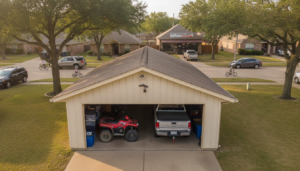
Comprehensive handles the non-collision events, and there are more of those than people expect. Theft out of a garage or off a trailer. Vandalism. Fire. Weather damage. And DFW weather is no joke. Hail, high winds, and severe storms move through our area all the time, and an ATV parked outside or in an exposed structure can take real damage. Comprehensive coverage is built for exactly those scenarios.
Here’s the pattern we see. A rider carries liability because they understand they need to protect others, then skips collision and comprehensive to keep things simple. Then a storm hits, or a thief shows up, or the machine rolls, and they realize their own quad was never protected. Paying to repair or replace an ATV out of pocket is a rough surprise, especially on a vehicle that cost real money to begin with.
When these coverages matter most
If your ATV is newer, financed, or valuable, going without collision and comprehensive leaves a lot on the table. If you store it where weather or theft is a genuine risk, comprehensive is even more worth discussing. None of this means you have to buy every coverage out there. It means you should know what each one does, so the decision is yours and made on purpose, not by accident.
Mistake 4: Not insuring custom parts, accessories, and safety gear
ATV riders love to personalize their machines. Lift kits, upgraded tires, winches, lights, custom seats, performance parts. All of it can turn a stock quad into something a lot more capable and a lot more valuable. Riders also put money into gear: helmets, protective apparel, and specialized equipment that keeps them safer on the trail.
Here’s the catch. A standard ATV policy may be built around the base value of the machine and might not automatically count the full value of everything you’ve bolted on. If your ATV is worth considerably more because of aftermarket upgrades, and those additions aren’t spelled out in your policy, you could come up short after a theft or a bad accident.
This is one of the quieter common ATV insurance mistakes DFW riders make, because it only surfaces at claim time. A rider assumes their upgraded machine is covered for what it’s actually worth, then finds out the custom parts and accessories had to be discussed and added separately. The same goes for safety gear. If your helmet and apparel add up to a real investment, it’s worth asking how that gear is treated under your policy.
The fix is simple. Make a list of your upgrades and gear, roughly estimate their value, and bring that to your coverage conversation. An agent can walk you through options for covering custom parts, accessories, and equipment so your protection reflects the machine you actually ride, not the stripped-down version that rolled off the lot.
Mistake 5: Not covering all operators or the way you actually use the ATV
ATVs get shared. A spouse takes a turn. The teenager wants to ride. A friend borrows it for the weekend. That sharing is part of the fun, and it creates coverage questions people rarely think about until something goes wrong.
Some policies include restrictions tied to the age or experience of the operator. If someone who falls outside those parameters is riding when an incident happens, coverage could be affected. That’s why it pays to be clear about who in your household and circle might realistically operate the machine, and to make sure your policy accounts for them rather than assuming anyone can hop on.
How you use the ATV matters just as much. There’s a real difference between recreational trail riding, utility work around a property, and competitive or racing activity. Many policies are written with specific uses in mind, and using an ATV for something the policy doesn’t contemplate, like commercial work or racing, could put your coverage at risk. If you ever plan to use your machine for an event, a side business, or anything beyond ordinary recreation, that’s a conversation to have ahead of time, not after a claim.
Consider a composite of families we work with across the DFW area: parents who bought an ATV mostly for weekend recreation, then started using it to haul materials around a few acres and occasionally let a young, newly riding family member take it out. Nothing about that is unusual. But each of those changes is worth checking against the policy so there are no surprises later.
Matching your coverage to your real operators and real uses is one of the most overlooked common ATV insurance mistakes DFW riders make. It’s also one of the easiest to fix with a quick, honest review.
Mistake 6: Forgetting about uninsured and underinsured rider protection
You can do everything right and still get hurt by someone else’s choices. On shared trails and riding areas, you’re not the only one making decisions about coverage. Plenty of other riders carry little or none. If one of them causes an accident that injures you or damages your ATV, their thin coverage becomes your problem.
That’s where uninsured and underinsured motorist protection comes in, similar in spirit to the version you may know from auto insurance. It’s designed to help with your medical expenses and property damage when the at-fault rider can’t cover what they caused. For DFW riders who share trails with strangers, it’s a worthwhile layer of protection that’s easy to overlook, since it only matters when someone else drops the ball.
We list this among the common ATV insurance mistakes DFW riders make because riders tend to focus only on their own behavior when planning coverage. But insurance is partly about protecting yourself from everyone else out there. Ask your agent how uninsured and underinsured protection could fit your situation, especially if you ride busy public areas.
Mistake 7: Never reviewing your policy after you set it up
Insurance is not a set-it-and-forget-it purchase, yet that’s exactly how many riders treat it. They set up a policy once, feel relieved, and never look at it again. Meanwhile their riding life keeps changing.
Think about everything that can shift in a year. You might add a second ATV. You might install new upgrades or buy expensive gear. New trails and riding areas open up, changing where and how far you ride. A teenager grows into a new rider. You move, or you change how and where you store the machine. Each of those changes can affect whether your coverage still fits, and a policy that was perfect last season can quietly fall out of step.
Reviewing your ATV policy about once a year is one of the simplest habits that keeps the common ATV insurance mistakes DFW riders make from sneaking up on you. A short annual check-in lets you update values, add operators, adjust for new uses, and confirm your protection still matches reality. At DRH Insurance Group we’re glad to sit down and walk through your policy so it keeps up with your riding instead of lagging behind it.
What a yearly review actually looks like
It doesn’t have to be a big production. A good review usually comes down to a few questions. Has the value of your ATV changed? Did you add parts, accessories, or gear? Is anyone new riding it? Has your usage shifted at all? Did you change where it’s stored? Running through that short list once a year keeps your coverage honest and helps you catch gaps before a claim does it for you.
Mistake 8: Ignoring discounts you might qualify for
The last item on our list of common ATV insurance mistakes DFW riders make is leaving potential savings on the table. We can’t promise specific discounts, amounts, or outcomes, and every situation is different. What we can tell you is that discounts often exist, and riders frequently never ask about them.
Depending on the carrier and your circumstances, savings opportunities may be tied to things like completing an approved ATV safety course, bundling your ATV policy with other coverage such as home or auto through the same agency, insuring more than one ATV, or installing anti-theft devices. Some of these also happen to make you a safer, better-protected rider, which is a nice bonus beyond any possible effect on your premium.
The point is to ask. When you review your coverage, raise the question of what discounts might apply to your situation. An agent can tell you which ones are realistic for you instead of leaving you to guess. Not asking is how riders quietly pay more than they might need to, and it’s an easy habit to break.
Putting it all together: avoiding the common ATV insurance mistakes DFW riders make
Look back over these eight mistakes and a theme shows up. Almost every one comes from an assumption nobody stopped to examine. People assume their home or auto policy covers the ATV. They assume minimum liability is enough. They assume their own machine is protected, that their upgrades are included, that anyone can ride, that other riders carry insurance, that last year’s policy still fits, and that there’s nothing to save. Each assumption feels reasonable. Each one can cost real money at the worst possible moment.
The good news is that none of this is hard to fix. You don’t need to memorize policy language or become an insurance expert. You just need to pause before you ride, take an honest look at your coverage, and ask specific questions. How and where am I actually covered? Is my liability realistic for the way I ride? Is my own machine protected against collisions, theft, and DFW weather? Are my upgrades and gear accounted for? Does my policy match who rides and how we use it? Do I have protection against underinsured riders? Have I reviewed any of this lately? Am I missing discounts I could ask about?
Working through those questions is how you move from guessing to knowing. The common ATV insurance mistakes DFW riders make are common precisely because they’re easy to overlook, and they get uncommon the moment you shine a little light on them.
We’re a local team with offices in Grand Prairie and Duncanville, and we genuinely enjoy helping our neighbors understand their options so they can ride with confidence. Nothing here is a recommendation to buy a particular coverage or a promise about any outcome. It’s meant to help you ask better questions. When you’re ready, we’d be glad to sit down, look at how you ride, and talk through the choices that make sense for you and your family. No pressure. Just a straightforward conversation about protecting something you love to do.
Frequently asked questions
Does my homeowners or auto insurance cover my ATV in the DFW area?
Usually not in any meaningful way. Homeowners insurance often provides only limited liability coverage while the ATV is on your own property, and it typically doesn’t follow you to trails or riding areas off-property. Auto insurance almost never extends to an ATV at all, which is why many riders carry a dedicated ATV policy.
What does ATV insurance typically cover beyond liability?
On top of liability for injuries or property damage you cause to others, an ATV policy can include collision coverage for damage to your own machine in an accident and comprehensive coverage for events like theft, vandalism, fire, and weather damage. Many policies can also address custom parts, accessories, and uninsured or underinsured rider protection. The right mix depends on your situation and is worth discussing with an agent.
Are custom parts and upgrades on my ATV automatically covered?
Not always. A standard policy may be based on the base value of the machine and might not fully account for aftermarket upgrades, accessories, or specialized gear. If you’ve put money into custom parts, it’s worth asking your agent how to make sure that value shows up in your coverage.
Can anyone ride my ATV and still be covered?
It depends on your policy. Some ATV policies include restrictions related to the age or experience of the operator, and an incident involving someone outside those parameters could affect coverage. If family members or friends ride your ATV, let your agent know so your policy can account for them.
How often should I review my ATV insurance policy?
Reviewing your ATV policy about once a year is a good habit. New upgrades, additional machines, new riders, changes in how or where you ride, and different storage situations can all affect whether your coverage still fits. A short annual check-in helps keep your protection current.
Where can I talk to someone about ATV insurance in the DFW area?
Our team at DRH Insurance Group has offices in Grand Prairie and Duncanville, Texas, and we’re happy to walk through how you ride and what coverage options might fit. We focus on explaining your choices in plain English so you can decide what makes sense for you. There’s no pressure, just a straightforward conversation.