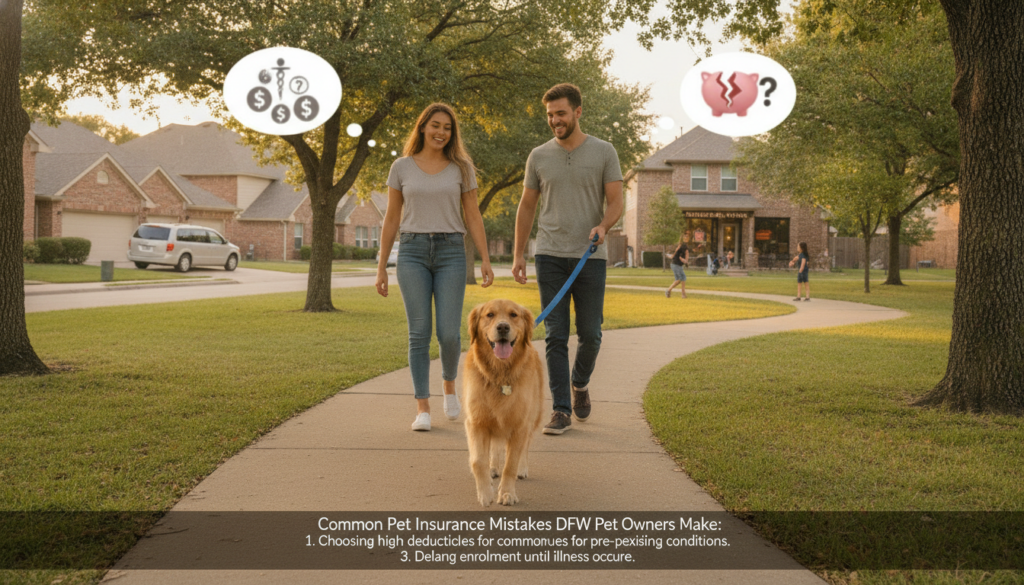
Pet insurance trips up a lot of Dallas-Fort Worth families because it does not work like the auto or home policies most of us already know. You have a dog curled up at your feet or a cat on the windowsill, and they are family. Then they surprise you with a vet trip you never saw coming. That is why so many people in this area start looking into coverage. The catch is that a few honest misunderstandings about how the policies work can lead to denied claims and bigger out-of-pocket bills than you expected.
At DRH Insurance Group, we spend a lot of time helping DFW families work through coverage questions in plain English. Pet insurance comes up more and more, especially from folks in Grand Prairie and the surrounding towns who want to take care of their animals without getting blindsided. So we put together this guide to the most common pet insurance mistakes DFW pet owners make, and how to sidestep each one before you ever file a claim.
This is educational information, not a push to buy any specific plan. Every pet, budget, and household is different, and the right choice is something worth talking through with an agent. The goal here is simple. We want you to walk into that conversation already knowing how these policies work.
Why understanding common pet insurance mistakes DFW owners make matters
Here is the thing about pet insurance. The policy you sign up for today is built to help with health problems that have not happened yet. It is forward-looking by nature. That one detail is behind most of the confusion and frustration we hear about.
When a family in Grand Prairie tells us they feel burned by a pet policy, it almost always traces back to an expectation that did not match how the plan actually worked. They expected a pre-existing condition to be covered. They assumed routine shots were included. They thought coverage started the day they paid. None of those are crazy assumptions. But they are assumptions, and pet insurance rewards the people who read the details.
The good news is that the common pet insurance mistakes DFW pet owners make are almost entirely avoidable once you know what to look for. You do not need to be an insurance expert. You just need to understand a handful of concepts, ask the right questions, and compare plans on more than price. Let us go through them one at a time.
Mistake 1: Waiting until your pet is sick or older
This is the big one, and it is the single costliest of the common pet insurance mistakes DFW pet owners make. The instinct is understandable. When your pet is young, healthy, and bouncing around the backyard, insurance feels like something you can deal with later. Then a limp, a lump, or a strange cough shows up, and suddenly you are shopping for a policy in a panic.
The problem is that pet insurance generally does not cover pre-existing conditions. A pre-existing condition is any illness or injury that showed up before your coverage started, or during the policy’s waiting period. If your dog was already diagnosed with hip dysplasia, or your cat has been showing symptoms of a chronic issue, those specific conditions will typically be excluded going forward. There are some narrow exceptions for curable conditions that have been symptom-free for a long stretch, but you cannot count on that, and it varies by insurer.
Age matters too. Premiums for pet insurance tend to rise as pets get older, because older animals statistically need more care. An older pet may also face more exclusions or fewer plan options. None of this means an older pet cannot be insured. It just means your choices narrow and your costs generally climb the longer you wait.
How to avoid it: If you are even thinking about pet insurance, the most protective time to look into it is while your pet is young and healthy, before any condition exists to be excluded. A puppy or kitten enrolled early has the widest runway, because almost nothing has had a chance to become pre-existing yet. If you have an older pet, do not assume the door is closed. It just means being realistic about what will and will not be eligible, and planning accordingly.
Think of it this way. Pet insurance is an umbrella you buy before the storm. Once the rain starts, the specific thing getting you wet is the one thing the umbrella will not cover.
Mistake 2: Ignoring waiting periods
Here is a detail that catches a surprising number of people. Coverage does not usually begin the moment your payment clears. Most pet insurance policies have a waiting period, which is a set window of time that has to pass after you enroll before certain coverage becomes active.
Waiting periods are not all the same length, and they often differ by category. A policy might have a short waiting period for accidents, a longer one for illnesses, and an even longer one for specific things like orthopedic or cruciate ligament conditions. If your pet gets hurt or sick during one of those waiting windows, a claim for that issue will generally be denied, even though you are paying premiums.
This is where timing really matters. If you wait until your dog is already favoring a leg to enroll, you are stacking two problems. The condition may already count as pre-existing, and even if it did not, the waiting period may not have passed yet. Either one can sink the claim.
How to avoid it: Read exactly how long each waiting period is, and for which categories, before you enroll. Then get coverage in place well ahead of any emergency so those clocks have time to run out. The whole point is to be past the waiting periods and fully active long before you ever need to use the policy. Skipping this is one of the quieter common pet insurance mistakes DFW pet owners make, because the plan looks active on paper even when parts of it are not yet live.
Mistake 3: Assuming all plans are the same or shopping on price alone
If you line up three pet insurance plans and only look at the monthly premium, you are missing most of the story. Pet insurance plans vary a lot in what they actually do for you, and the cheapest one on paper can easily turn into the most expensive one when a real vet bill shows up.
Three levers do the heavy lifting in any pet policy. The deductible, the reimbursement percentage, and the annual payout limit. A plan with a low monthly cost often pairs that with a lower reimbursement rate, a higher deductible, or a lower annual cap. That combination means more of a big vet bill lands on you.
Let us make that concrete with a simple, hypothetical example. Imagine two plans. Plan A has a lower premium but reimburses a smaller share of eligible bills and has a higher deductible. Plan B costs a bit more each month but reimburses a larger share and has a lower deductible. In a routine year with no major issues, Plan A looks like the winner. But the first time your pet needs surgery and the bill is significant, Plan B can leave far more money in your pocket. Which one is genuinely cheaper depends entirely on what happens, and that is the part nobody can predict.
How to avoid it: Compare the full structure of each plan, not just the premium. Look at what is covered, what is excluded, the deductible type and amount, the reimbursement percentage, and the annual limit together, as a package. Price is one input, not the decision. Treating premium as the whole picture is one of the most common pet insurance mistakes DFW pet owners make, and it is also one of the easiest to fix once you know the other numbers to ask about.
Mistake 4: Not reading the fine print
Nobody loves reading policy documents. We get it. But with pet insurance, the fine print, sometimes called the policy terms or product disclosure, is where every meaningful promise and limit actually lives. It spells out what is covered, what is excluded, how claims are handled, and what caps and conditions apply.
This is where a lot of unpleasant surprises hide. A policy might exclude certain hereditary or congenital conditions. It might cover prescription supplements only while you are actively treating a covered illness, not as a general wellness item. It might put specific caps on things like behavioral health support, dental work, or alternative therapies. None of that is hidden on purpose. It is just in the document, and plenty of owners skim past it until a claim gets denied.
Breed-specific exclusions deserve a close look. Some breeds are prone to known conditions, and some policies treat those conditions differently. If you own a breed with a well-documented health tendency, the fine print is exactly where you find out how, or whether, that tendency is covered.
How to avoid it: Actually read the exclusions and limits section before you enroll, or ask an agent to walk you through it. Make a short list of the health risks most relevant to your specific pet, then check the document to see how each one is handled. Treating the fine print as optional reading is one of the most common pet insurance mistakes DFW pet owners make, and it is the one most likely to turn into a denied claim at the worst possible moment.
Mistake 5: Not understanding your financial responsibility beyond the premium
The monthly premium is only the first number that matters. Two others decide how much a vet visit actually costs you. Your deductible and your reimbursement percentage. Getting either one wrong is one of the common pet insurance mistakes DFW pet owners make, because it changes the math on every single claim.
The deductible is the amount you pay out of pocket before the plan starts reimbursing. Deductibles come in different flavors. Some are annual, meaning you meet it once per policy year. Others are per-condition, meaning you may face a separate deductible for each distinct health issue. Those two structures behave very differently over the life of a pet with multiple conditions, so it is worth knowing which one a plan uses.
The reimbursement percentage is how much of the eligible bill the insurer pays back after you have met the deductible. Common reimbursement levels tend to land within a range, and the difference between the low end and the high end is real money on a large bill. If a plan reimburses a given percentage of an eligible bill, you are responsible for the rest, plus anything the plan does not consider eligible in the first place.
Here is how the pieces fit together in practice. Say your pet has a covered procedure. First, you cover the deductible. Then, of the eligible amount that remains, the plan reimburses its percentage and you pay the rest. If the plan has an annual limit, reimbursement stops once you hit that cap for the year. Understanding this sequence ahead of time means no surprises when the statement arrives.
How to avoid it: Before you choose anything, make sure you can explain, in your own words, your deductible type and amount, your reimbursement percentage, and your annual limit. If you cannot, you do not yet know what the plan will cost you when it counts. An agent can help you run through a realistic scenario so the numbers feel concrete instead of abstract.
Mistake 6: Not matching the coverage type to your pet’s actual needs
Pet insurance is not one single product. It generally comes in a few flavors, and choosing a type that does not fit your pet is one of the common pet insurance mistakes DFW pet owners make without even realizing it.
The main categories you will run into are:
- Accident-only coverage. This helps with injuries, like a broken bone or a swallowed object, but not illnesses. It tends to be the most limited option.
- Accident and illness coverage. This is the broader tier that helps with both injuries and illnesses, from infections to chronic conditions, subject to the plan’s terms and exclusions.
- Wellness add-ons. Routine care like vaccinations, annual exams, and dental cleanings is usually not part of a standard accident and illness policy. It is often available only as a separate optional add-on.
That last point trips people up constantly. Many owners assume their policy will cover the yearly checkup and shots, then learn at claim time that routine and preventive care was never included unless they added a wellness plan. That is not the insurer hiding the ball. It is just how most pet insurance is built. Standard policies are designed around the unexpected, not the routine.
Your pet’s breed, age, and known risks should guide the type of coverage you consider. A large-breed dog, for example, may be more prone to musculoskeletal issues, so whether orthopedic conditions are covered, and after what waiting period, becomes a meaningful question. A breed with known hereditary tendencies raises a different set of questions. There is no universal right answer, which is exactly why matching the coverage type to the specific animal matters so much.
How to avoid it: Start with your pet, not the plan. Write down their age, breed, and any health tendencies that breed is known for. Then look at which coverage type, and which add-ons, line up with that profile. Picking a plan in the abstract, without thinking about your actual pet, is a reliable way to end up with the wrong fit.
Mistake 7: Not shopping around and comparing policies
The pet insurance market is competitive, and that is good news for you. Different providers offer different coverage structures, different waiting periods, different exclusions, and different pricing. The plan that fits a neighbor’s senior cat may be a poor fit for your young, active dog, and the other way around.
Skipping the comparison step is one of the most common pet insurance mistakes DFW pet owners make, simply because it leaves value on the table. When you only look at a single option, you have no frame of reference for whether its deductible is reasonable, its exclusions are typical, or its limits are generous. Comparison is what turns a leap of faith into an informed decision.
When you compare, put the plans side by side on the things that actually move the needle. Covered conditions, exclusions, deductible type and amount, reimbursement percentage, annual limits, and the length of each waiting period. Premium belongs on that list too, but only as one line item among several, not as the headline.
How to avoid it: Gather details on more than one plan before you commit, and compare them on structure, not just cost. This is exactly the kind of legwork our team at DRH Insurance Group is glad to help Grand Prairie pet owners work through, so you are weighing real apples against real apples instead of guessing.
A quick checklist to avoid the common pet insurance mistakes DFW owners make
If you take nothing else from this guide, take this short list. Before you enroll in any pet insurance plan, make sure you can answer each of these for yourself:
- Am I enrolling while my pet is relatively young and healthy, before conditions become pre-existing?
- Do I know the exact length of each waiting period, and for which categories?
- Have I compared more than one plan on structure, not just on monthly price?
- Have I actually read the exclusions and limits, including anything breed-specific?
- Can I clearly state my deductible type, my reimbursement percentage, and my annual limit?
- Does the coverage type match my pet’s real needs, and do I understand that routine care usually requires a separate wellness add-on?
If you can check every box, you have already dodged the common pet insurance mistakes DFW pet owners make most often. If you cannot, those are precisely the questions to bring to an agent.
How DFW pet owners can think through these choices
It helps to picture how this plays out for a real household. Consider a composite of families we work with around Grand Prairie. A young couple with a new puppy who want broad protection for the years ahead, and an older couple whose senior dog already has a known health issue. These two households should not be shopping for the same thing.
For the couple with the puppy, enrolling early is the move that quietly pays off, because almost nothing has had time to become a pre-existing condition. Their biggest tasks are understanding waiting periods and choosing a coverage type with room to grow as the dog ages. For the couple with the senior dog, the conversation is more about realistic expectations. Knowing the existing condition will likely be excluded, and focusing on what can still be protected. Neither household is making a mistake by having a different plan. They are just matching coverage to their actual situation, which is the whole point.
Notice that none of this is about finding the single best pet insurance policy in all of DFW. There is no such thing, because best depends entirely on your pet and your budget. What exists instead is the plan that fits you, found by avoiding the common pet insurance mistakes DFW pet owners make and asking better questions up front.
Pet insurance is not a scam and it is not magic. It is a tool. Used well, with your eyes open to waiting periods, exclusions, deductibles, and reimbursement rates, it can turn a frightening vet bill into something manageable. Used blindly, it can lead to the exact frustration we hear about. The difference between those two outcomes is almost always the homework done before enrolling.
Let us talk through your options
Every pet is different, and so is every family’s budget and comfort with risk. The seven common pet insurance mistakes DFW pet owners make are all avoidable, but avoiding them starts with understanding how these policies actually work, which is what we have tried to lay out here.
If you are weighing pet insurance for your dog, cat, or any other member of the family, our team at DRH Insurance Group is happy to help you make sense of the options and compare plans on the details that matter. We work with pet owners across Grand Prairie, Duncanville, and the wider DFW area, and we are glad to answer questions at your pace, with no pressure. When you are ready, reach out and let us talk through what makes sense for your household and your pet.
Frequently asked questions
When is the best time to buy pet insurance for my pet in DFW?
The most protective time is while your pet is young and healthy, before any condition can be labeled pre-existing. Premiums generally rise as pets age, and older pets may face more exclusions. Enrolling early gives you the widest range of eligible coverage.
Does pet insurance cover pre-existing conditions?
Generally no. Most pet insurance excludes conditions that appeared before coverage started or during a waiting period, though some insurers make narrow exceptions for curable issues that have been symptom-free for a long time. This is why timing your enrollment early matters so much.
What is a waiting period in pet insurance and why does it matter?
A waiting period is the set time that must pass after you enroll before certain coverage becomes active, and it often differs for accidents, illnesses, and orthopedic conditions. Claims filed during a waiting period are typically denied. Securing coverage well before any emergency lets those clocks run out.
Does pet insurance cover routine care like shots and dental cleanings?
Standard accident and illness policies usually do not cover routine or preventive care. Vaccinations, annual exams, and dental cleanings are generally available only through a separate optional wellness add-on. Always confirm what is included before assuming routine visits are covered.
How do deductibles and reimbursement percentages affect what I pay?
The deductible is what you pay out of pocket before the plan reimburses, and it may be annual or per-condition. The reimbursement percentage is the share of the eligible bill the insurer pays back after the deductible is met. Together with the annual limit, these numbers decide your real out-of-pocket cost on any claim.
Should I pick the pet insurance plan with the lowest premium?
Not automatically. A low premium often comes with a lower reimbursement rate, a higher deductible, or a lower annual limit, which can mean paying more when a big vet bill arrives. Compare plans on their full structure, including coverage, exclusions, and limits, rather than price alone.
Sources
- Common Pet Insurance Mistakes – Finhabits
- 7 Pet Insurance Mistakes to Avoid – Experian
- 8 Nasty Pitfalls to Avoid When Comparing Pet Insurance
- How to avoid seven of the most common pet insurance pitfalls – Vets Now
- Buying pet insurance? Avoid these 3 mistakes – CBS News
- 7 Costly Pet Insurance Mistakes Every Owner Should Avoid – Petsfolio