If you drive in Dallas-Fort Worth, a wreck is a real possibility, so it pays to know the steps before one happens. Nobody plans their day around a fender bender on the LBJ Freeway or a rear-end bump at a red light in Arlington. But from the mixmaster near downtown Dallas to the North Tarrant Express lanes, the odds of a collision at some point in your life are real. When it happens, the minutes right afterward can feel like a blur of adrenaline and worry. That is exactly why a plan helps.
At DRH Insurance Group, we walk DFW drivers through this process all the time, and we have seen how much smoother things go when people know what to expect. This guide covers both halves of the story. First, what to do in the chaotic opening minutes at the scene. Then, how to actually move through the claim. The goal is simple. We want you to feel prepared and in control, so that when something does happen, you already know the plan.
Why Knowing What to Do After a Car Accident DFW Insurance Claim Steps Matters
Dallas-Fort Worth is one of the busiest metro areas in the country for drivers. Between the daily commute crush on Interstate 35, the weekend crowds heading to events in Frisco and the Stockyards, and the construction zones that seem to appear overnight, a lot of traffic shares a lot of pavement. More cars on the road means more chances for the unexpected.
The first few minutes matter so much because they shape everything that follows. The information you gather, the photos you take, and the way you handle yourself at the scene all feed directly into how your claim unfolds later. A clear, organized start makes the whole process easier. A scattered start can leave gaps that slow things down.
That is really the heart of what to do after car accident DFW insurance claim preparation. It is not about memorizing a legal rulebook. It is about having a short mental checklist so you can act with purpose when your heart is pounding. Think of it like a fire drill. You hope you never need it, but you are glad you practiced.
Throughout this article, we will keep things practical and specific to the DFW area. We will point out the Texas details that matter, like the state crash report and reporting thresholds, and we will flag the moments where a quick call to our team can save you a headache. No scare tactics, no fine print games. Just the plain-English version of what helps.
Immediate Steps at the Accident Scene in DFW
Everything that happens in the first several minutes after a collision falls into one bucket. Protect people first, then protect the facts. Here is how we recommend thinking through it.
1. Prioritize Safety and Check for Injuries
Your first concern is safety, not paperwork. If your vehicle is drivable and it is safe to do so, ease it over to the shoulder or a nearby parking lot, well away from moving traffic. Turn on your hazard lights so other drivers can see you. On a road like I-635 or US-75 during rush hour, staying in a live lane is genuinely dangerous, so getting clear of traffic is a big deal.
Once you are in a safer spot, check yourself and your passengers. Adrenaline is powerful, and it can hide pain for a surprisingly long time. You might feel completely fine in the moment and then wake up the next morning sore all over. Take a breath and honestly assess how everyone is doing. If it is safe, check on the people in the other vehicles too. One caution here. Do not move anyone who appears seriously injured unless they are in immediate danger, such as from fire. Moving someone with a possible neck or spine injury can make things worse. Let the paramedics handle it.
2. Call 911 and Report the Accident
Dial 911 right away. In Texas, calling it in is especially important when there are injuries, a fatality, or property damage that looks like it tops $1,000. Given what vehicle repairs cost now, that threshold is crossed very easily, so when in doubt, make the call.
An officer responding to the scene does two valuable things. First, they help manage traffic and keep everyone safe from secondary crashes, which are a real risk on busy DFW roads. Second, they create an official, neutral record of what happened. That police report becomes one of the most useful documents in the entire what to do after car accident DFW insurance claim journey, because it captures details while they are fresh, from a party with no stake in the outcome.
3. Stay Calm and Do Not Admit Fault
This one is tough because emotions run high. You might feel flustered, embarrassed, or even sure that you caused the crash. Resist the urge to apologize in a way that sounds like accepting blame, and do not get into an argument with the other driver. A simple, calm exchange is all you need at the scene.
Fault in a crash is often more complicated than it feels in the moment. Road conditions, timing, visibility, and what the other driver was doing all factor in. Let the facts and the investigation sort it out rather than deciding on the spot.
Statements made at the scene can be repeated and interpreted later by insurance companies. Stick to the facts, be polite, exchange what you need, and leave the conclusions to the people whose job it is to review the evidence.
4. Exchange Information With Everyone Involved
Once the immediate danger has passed and, ideally, with the police present, exchange information with the other drivers. Here is the short list of what to collect from each one:
- Full name and phone number
- Driver’s license number
- License plate number
- Vehicle description, including make, model, and year
- Insurance company name and policy information
Do not forget witnesses. If someone saw the crash and is willing to share their name and phone number, grab it. A neutral witness can be a huge help if there is ever a disagreement about what happened. In a busy spot like a Plano shopping center lot or a downtown Fort Worth intersection, there are often people around who saw the whole thing.
5. Gather Evidence and Document the Scene
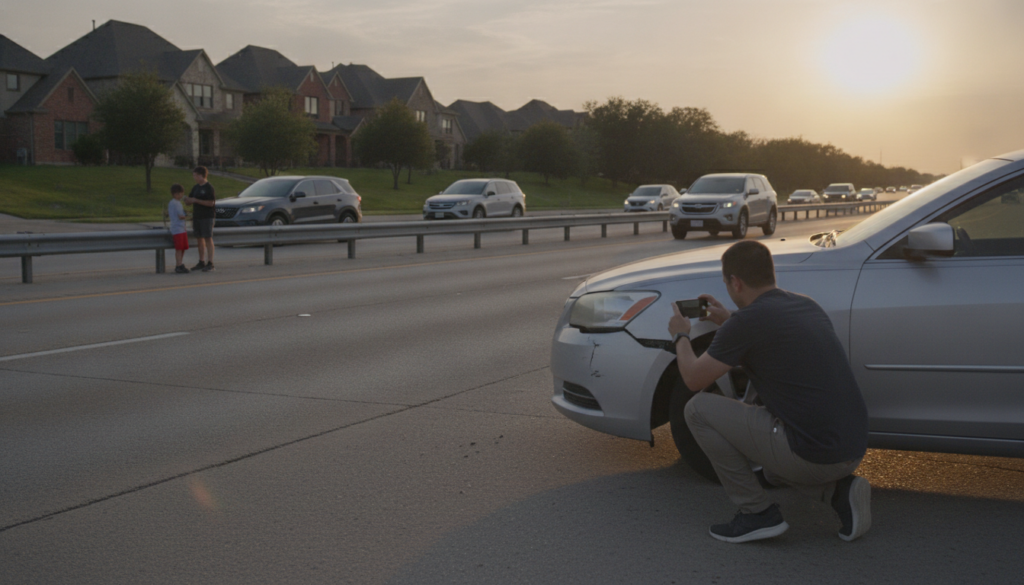
Your phone is one of the best tools you have. If it is safe to move around, take clear photos and short videos from several angles. Capture:
- Damage to your vehicle and to the other vehicles
- The overall position of the cars before they are moved, if possible
- Skid marks on the pavement
- Road and weather conditions
- Traffic signals, stop signs, and lane markings
- Nearby landmarks or street signs that pin down the location
Think of yourself as telling the story of the scene with pictures. Months later, nobody remembers exactly how the cars were angled or whether it had just rained. Photos remember for you. This documentation is a cornerstone of what to do after car accident DFW insurance claim handling, because it gives your adjuster concrete, visual facts to work with instead of fuzzy recollections.
6. Seek Medical Attention Promptly
Even if you walk away feeling fine, we encourage you to get checked out. Some injuries, like concussions, whiplash, and certain internal injuries, do not announce themselves right away. They can creep up over hours or days. A prompt medical evaluation does two things for you. It protects your health, which is the whole point, and it creates a dated record that connects any symptoms to the accident. That record matters down the line if your claim involves injury-related coverage.
If you ever feel dizzy, foggy, numb, or in significant pain, treat it as urgent. Your well-being always comes before any claim consideration.
How to Start Your What to Do After Car Accident DFW Insurance Claim
Once everyone is safe and you have left the scene, the second half begins. This is the part where many drivers feel unsure, so we will take it slowly. The good news is that you do not have to work through it alone. Our team at DRH Insurance Group is here to help.
1. Notify Your Insurance Provider Promptly
Reach out to us as soon as you reasonably can, even if you are convinced the other driver was at fault. Reporting early keeps your options open and gets the process moving. When you call, have your policy number handy and be ready to share the basic facts:
- Date and time of the crash
- Location, as specific as you can be
- Vehicles involved
- A brief, factual description of what happened
You do not need to have every detail figured out. You do not need to assign blame. You just need to give an honest, straightforward account of the events. The sooner we know, the sooner we can help guide your what to do after car accident DFW insurance claim from start to finish.
2. Understand Your Policy Before You Need It
One of the best favors you can do your future self is to understand your coverage before a crash ever happens. Auto policies include different parts that do different jobs, and knowing what you carry removes a lot of the mystery. Common coverage types you may hear about include:
- Liability coverage, which generally relates to damage or injury you may be responsible for to others.
- Collision coverage, which generally relates to damage to your own vehicle from a collision.
- Comprehensive coverage, which generally relates to things like theft, hail, or hitting an animal.
- Personal injury protection, which relates to certain medical and related costs.
We are describing these in general terms on purpose. The specifics of what applies to any situation depend on your individual policy and the facts of the claim. We never want to tell you what you should have bought or interpret your policy as a legal document. Instead, we are happy to sit down with you and walk through what your current coverage includes and what the options are. Knowing your deductible amounts ahead of time is also helpful, because it sets realistic expectations for how a repair claim might work.
3. Cooperate With Your Claims Adjuster
After you file, a claims adjuster is assigned to your case. The adjuster reviews the facts, looks at the documentation, and works through the claim. The single best thing you can do here is cooperate fully and stay organized.
Provide the documents and information the adjuster requests in a timely way. And keep a simple log of every interaction. A notebook or a notes app works fine. For each contact, jot down:
- The date and time
- The name of the person you spoke with
- A short summary of what was discussed
- Any next steps or deadlines mentioned
This kind of record keeping sounds tedious, but it pays off. It keeps you from re-explaining things, it prevents details from slipping through the cracks, and it gives you a clear picture of where your claim stands. Good documentation is quietly one of the most powerful tools in the entire what to do after car accident DFW insurance claim process.
4. Obtain the Official Police Report (the CR-3)
In Texas, when an accident involves injury, death, or property damage that tops $1,000, the responding officer is required to file a crash report with the Texas Department of Transportation within 10 days. This document is commonly called the CR-3. It is an objective record, and it typically includes driver and vehicle information, insurance details, statements, road conditions, and the officer’s read of the scene.
You can request your crash report through TxDOT’s Crash Records Information System, often shortened to CRIS. It is available online, and there is a small fee to obtain a copy. Getting this report into your file early is smart, because adjusters and other parties often reference it. It is one of the few documents that speaks with a neutral voice about what happened, which is exactly why it carries weight in a what to do after car accident DFW insurance claim.
5. Document All Expenses Carefully
From the moment of the crash forward, keep careful records of anything you spend because of it. That includes:
- Medical bills and related costs
- Car repair estimates and invoices
- Towing fees
- Rental car costs
- Lost wages if you miss work
Save every receipt, every estimate, and every statement. Create a folder, digital or physical, and drop everything in it as it comes. When it is time to review your claim, having all the paperwork in one place makes the conversation faster and clearer. It also means you are not scrambling to remember what the towing company charged three weeks ago. Thorough expense tracking is a huge part of staying on top of your what to do after car accident DFW insurance claim.
6. Be Cautious About Recorded Statements and Early Signatures
Here is a step that trips up a lot of people. If the other driver’s insurance company contacts you and asks for a recorded statement, be careful. You are generally not required to give the other party’s insurer a recorded statement on the spot, and it is reasonable to consult your own agency, or an attorney if the situation warrants it, before you do. The same goes for signing any release or settlement document. Never sign something you do not fully understand.
A release can close the door on future claims related to the accident. Once it is signed, it is very hard to reopen. Take the time to read, ask questions, and understand what you are agreeing to before you put your name on anything.
We are not here to give you legal advice, and we would never pretend to. What we can do is help you understand the general lay of the land and point you toward asking the right questions. If anything feels rushed or confusing, that is your signal to slow down. A careful approach here protects you throughout the rest of your what to do after car accident DFW insurance claim.
7. Follow Up Regularly
Claims move through steps, and sometimes those steps take time, especially if there are repairs, medical evaluations, or multiple parties involved. Stay in regular contact with your adjuster to check on the status. If they ask for additional information, send it over promptly, because delays on documentation often translate directly into delays on the overall timeline.
Polite, consistent follow-up keeps your claim from stalling and keeps you informed. And if you ever feel stuck or unsure what the next move is, that is exactly the kind of moment our team is glad to help with. Supporting DFW drivers through each stage of a what to do after car accident DFW insurance claim is a big part of what we do.
Common DFW Accident Scenarios and How the Steps Apply
Sometimes it helps to see how the checklist plays out in real life. The following examples are composites, drawn from the kinds of situations DFW drivers commonly describe to us. They are illustrations, not specific real claims, but they show how the steps fit together.
The Rush Hour Rear-End on I-35
Picture a driver heading north on I-35E during the evening crawl. Traffic stops suddenly, and the car behind does not stop in time. The bump is minor, and both cars are drivable. In this scenario, the driver pulls to the shoulder, turns on hazards, and checks for injuries. Everyone feels okay, but there is property damage, so they call it in. They exchange information, snap photos of both bumpers and the lane they were in, and note the heavy traffic conditions. Later that evening, they report the incident to us with the basic facts and start a file. Because they documented the scene and reported quickly, the what to do after car accident DFW insurance claim moves forward without guesswork.
The Parking Lot Scrape in Plano
Now imagine a low-speed scrape in a crowded shopping center lot. No injuries, no police needed at the scene necessarily, but there is visible damage. Even in a seemingly small situation, the same instincts apply. The driver exchanges information with the other party, photographs both vehicles and the surrounding lot, and looks for any security cameras or witnesses nearby. They keep the repair estimate and any related receipts. Small incidents still benefit from careful documentation, because what looks minor can sometimes reveal more damage once a shop takes a closer look.
The Hail-Damaged Commute
DFW weather can turn quickly, and spring storms bring hail that dents hoods and cracks windshields. This is not a collision with another driver, but it is still a situation where documentation and prompt reporting matter. The driver photographs the damage, notes the date and location of the storm, and reaches out to review how their coverage applies. We describe these scenarios because the habits you build for a collision also serve you well for other kinds of claims. Thorough photos, quick reporting, and good records are the common thread across nearly every what to do after car accident DFW insurance claim.
Mistakes to Avoid During a What to Do After Car Accident DFW Insurance Claim
Over the years, our team has seen a handful of avoidable missteps come up again and again. None of them are catastrophic on their own, but each one can add friction to your claim. Here are the ones worth watching for.
- Waiting too long to report. Memories fade and details blur. Reporting promptly keeps the facts fresh and the process moving.
- Skipping the photos. It is easy to assume you will remember everything. You will not. Take more pictures than you think you need.
- Admitting fault at the scene. As we covered earlier, let the investigation determine fault. Stick to the facts in the moment.
- Not seeing a doctor because you feel fine. Delayed symptoms are common. A prompt checkup protects both your health and your record.
- Signing paperwork without understanding it. Never rush a signature on a release or settlement. Ask questions first.
- Losing track of expenses. Scattered receipts make everything harder. Keep one organized folder.
- Going silent with your adjuster. Claims need communication. Stay reachable and responsive.
Think of this list as the flip side of the checklist. Do the steps, avoid these traps, and your what to do after car accident DFW insurance claim will be far less stressful than it could otherwise be.
How DRH Insurance Group Supports DFW Drivers
Here is the thing we most want you to take away. You do not have to figure all of this out alone in the worst moment of your week. Our role as your local agency is to be a steady, familiar point of contact when things get confusing. We know the DFW roads, we know the questions that come up, and we are glad to help you understand your coverage before, during, and after a claim.
When you reach out to us after an accident, we can help you understand the steps, talk through what your policy generally covers, and point you toward the right resources, including how to request your CR-3 crash report through TxDOT’s CRIS system. We will not pressure you, we will not oversell you, and we will not pretend to give you legal advice we are not qualified to give. What we will do is explain things in plain English and treat you like the neighbor you are.
Preparation is the quiet hero of this whole topic. The drivers who handle a crash best are usually the ones who thought about it a little beforehand. They knew to call 911, to document the scene, to avoid admitting fault, and to report promptly. That is the entire spirit of understanding what to do after car accident DFW insurance claim steps ahead of time. You build the muscle memory now so you can rely on it later.
If you have questions about your current auto coverage, or you simply want to understand how your policy would respond in different situations, we would love to talk it through with you. There is no pressure and no rush. Reach out to the team at DRH Insurance Group whenever you are ready, and we will help you sort out the options that make sense for you and your family here in Dallas-Fort Worth.
Frequently asked questions
What should I do first after a car accident in Dallas-Fort Worth?
Prioritize safety by moving to a safe spot if you can and turning on your hazard lights. Check yourself and others for injuries, then call 911 to report the accident, especially if there are injuries or property damage over $1,000. Once everyone is safe, exchange information and document the scene with photos.
Do I have to call the police after a minor car accident in Texas?
In Texas, you should report an accident that involves injury, death, or property damage that tops $1,000, and modern repair costs cross that threshold easily. When in doubt, it is wise to call 911 so an officer can respond. An official crash report gives you a neutral record that helps with your claim.
How do I get a copy of my DFW crash report?
You can request your Texas crash report, often called the CR-3, through TxDOT’s Crash Records Information System, known as CRIS. It is available online for a small fee. Officers are required to file the report with TxDOT within 10 days when an accident meets the injury, death, or property damage threshold.
Should I give the other driver’s insurance company a recorded statement?
Be cautious before giving the other party’s insurer a recorded statement, since you are generally not required to do so on the spot. It is reasonable to consult your own agency, or an attorney if the situation warrants it, before agreeing. The same care applies to signing any release or settlement document.
How soon should I report an accident to my insurance agency?
Contact your insurance agency as soon as you reasonably can, even if you believe the other driver was at fault. Reporting early keeps your options open and gets the process moving while details are fresh. Have your policy number and the basic facts of the accident ready when you call.
What information should I collect at the accident scene?
Collect each driver’s full name, phone number, driver’s license number, license plate number, and vehicle make, model, and year, along with their insurance company and policy information. Also gather contact details from any witnesses. Take clear photos and videos of the vehicle damage, road conditions, and surroundings.