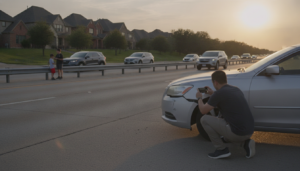
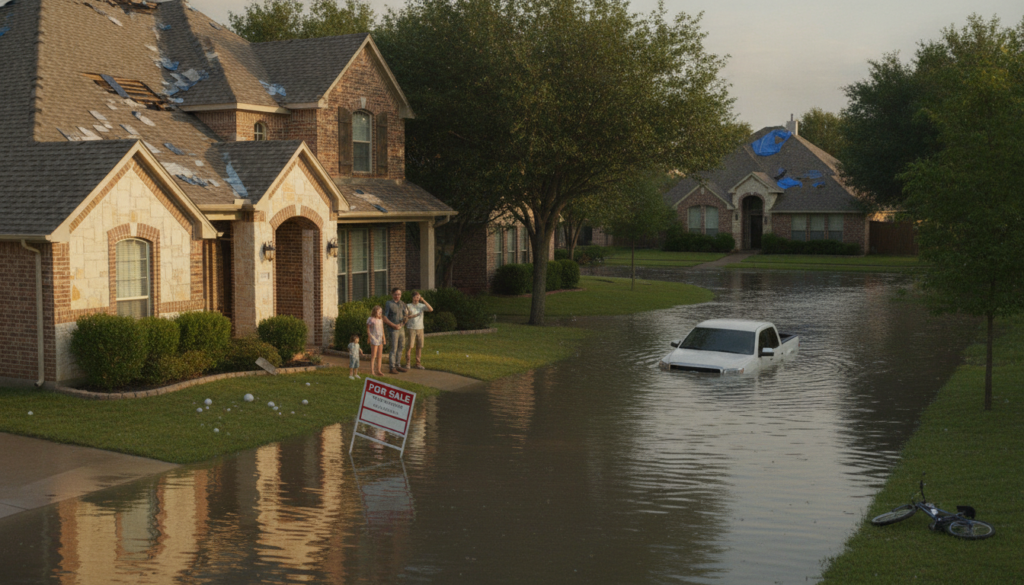
Most DFW homeowners don’t think hard about their insurance until a storm has already come and gone. If you’ve lived through even one North Texas spring, you know the routine. The sky turns a strange shade of green, your phone buzzes with a severe weather alert, and twenty minutes later your yard is buried under ice the size of golf balls. Hail and flooding are just part of life here in Dallas-Fort Worth. The problem is that the coverage questions people should be asking rarely come up until the damage is done.
I’m Dhyana Newton with DRH Insurance Group, and I talk with DFW families every week who get blindsided by something in their policy at the worst possible moment. Here’s the good news. Almost every one of those surprises can be avoided. This guide walks through the most common hail and flood insurance mistakes I see across the Metroplex, so you can understand your options and ask the right questions long before the next storm rolls through.
Why DFW homeowners face unique hail and flood risks
Dallas-Fort Worth sits in one of the most active severe-weather regions in the country. Spring and early-summer storms here produce large hail, damaging wind, and torrential rain, sometimes all in the same afternoon. The region has also grown fast. New rooftops, parking lots, and streets mean rain has fewer places to soak in, so water moves faster and pools in spots that never used to flood.
That combination is exactly why understanding Texas homeowner hail and flood coverage mistakes matters so much here. A policy that looks fine on paper can still leave you exposed if you don’t understand how your deductible works, what your roof coverage actually pays, or whether flooding is covered at all. Let’s start with hail, since that’s the one most DFW homeowners run into first.
The most common DFW hail insurance mistakes
Hail is the number-one reason DFW homeowners file property claims, and it’s also where I see the most confusion. Below are the DFW hail insurance mistakes that cost families the most money and cause the most frustration. Reading through them now is a lot easier than learning them the hard way after a storm.
1. Not understanding percentage-based wind and hail deductibles
This is probably the single most common of all the DFW hail insurance mistakes, and it catches even long-time homeowners off guard. A lot of people assume their deductible is a flat dollar figure like $1,000. But in Texas, wind and hail damage is frequently subject to a separate percentage-based deductible, often 1% or 2% of your home’s insured value instead of a set dollar amount.
Here’s why that matters. If your home is insured for $350,000 and you have a 2% wind and hail deductible, your out-of-pocket cost before coverage kicks in is $7,000, not $1,000. That’s a big gap if you were expecting a small flat deductible. I’ve sat across from homeowners who were genuinely stunned when they realized how their deductible worked. By then the storm had already hit.
The fix is simple. Pull out your declarations page today and look at how your wind and hail deductible is written. If you see a percentage, multiply it by your dwelling coverage amount so you know the real number. If you’re not sure how to read it, that’s exactly the kind of thing to talk through with an agent before storm season.
2. Choosing actual cash value roof coverage without realizing it
Roof coverage is where one of the most expensive Texas homeowner hail and flood coverage mistakes hides. Policies generally settle roof claims one of two ways: Actual Cash Value (ACV) or Replacement Cost Value (RCV).
An ACV policy pays the depreciated value of your roof. In plain English, the insurer factors in how old and worn your roof already was before the hail hit. A ten-year-old roof has lost a big chunk of its original value on paper, so an ACV settlement can leave you tens of thousands of dollars short of what a full replacement actually costs.
An RCV policy is generally broader. It’s designed to cover the cost of replacing your roof with new materials, typically reimbursing the depreciation piece after the repairs are actually finished. ACV coverage can look cheaper up front, which is exactly why some homeowners choose it without fully realizing what they’re giving up.
I’m not here to tell you which one belongs on your policy. That depends on your home, your roof’s age, and your budget. But I want you to know the difference exists so you can make an informed decision. If you’ve never checked which one you have, that’s worth a quick conversation.
3. Waiting too long to report hail damage
After a storm, life gets busy. You’re dealing with debris, maybe a broken fence, and the general chaos of a rough week. It’s easy to put off filing a claim, especially when the roof damage isn’t obvious from the ground. But delaying is one of the more avoidable DFW hail insurance mistakes.
Insurance policies typically have their own deadlines for reporting damage, and those deadlines are often much shorter than you’d expect. Texas law generally allows a longer window to pursue a lawsuit, but that’s a completely separate issue from your policy’s requirement to report damage promptly. Wait too long and you can complicate your claim or even get it denied, because the longer you wait, the harder it becomes to prove the damage came from a specific storm rather than general wear and tear.
My advice is to have your roof inspected after any significant hail event, even if everything looks fine from the driveway. Hail damage to shingles is often invisible from the ground but very clear once someone gets up close. If there’s damage, report it promptly.
4. Failing to document damage thoroughly
Insurers pay claims based on evidence. When you can’t clearly show what was damaged and when, they may question the cause or the extent, and that leads to undervalued or denied claims. Poor documentation is one of the quieter Texas homeowner hail and flood coverage mistakes, because homeowners don’t realize it’s a problem until the adjuster starts asking questions they can’t answer.
Here’s a simple habit that pays off. Take clear photos and video of your roof, siding, windows, screens, gutters, outdoor units, and fencing before storm season, then again after any major hail event. Date-stamped before-and-after images are powerful evidence. Keep detailed notes about the date of the storm and what you noticed afterward. Store everything somewhere you won’t lose it, like a cloud folder.
- Wide shots of each side of your home
- Close-ups of visible dents, cracks, or bruising on shingles
- Damaged screens, gutters, and window frames
- Any interior water spots or ceiling stains that appear later
- Photos of the hail itself, ideally next to a coin or ruler for scale
5. Skipping the adjuster inspection
When your insurance company sends an adjuster to inspect your home, being present and informed matters. If you’re not there, you can’t point out damage the adjuster might miss, and you can’t ask questions about how they’re evaluating the loss. Being absent or uninvolved is one of the DFW hail insurance mistakes that quietly shrinks settlements.
Walk the property with the adjuster if you can. Point out everything you documented. A lot of homeowners also find it helpful to have a trusted, reputable roofing contractor present who can speak to the full scope of what needs repair. The goal isn’t to be adversarial. It’s to make sure the assessment is complete and everyone is looking at the same damage.
6. Accepting the first estimate without a second look
An initial repair estimate is a starting point, not always the final word. Adjusters are human, and first estimates can miss hidden damage or underestimate the true cost of repairs, especially when materials and labor prices shift. Treating that first number as final is a common misstep.
It’s reasonable to get multiple repair bids from established, reputable local contractors so you understand what the work actually costs. If those bids turn up damage or costs the estimate didn’t account for, that’s information you can bring back to your insurer. Just be sure you’re comparing legitimate, licensed contractors rather than whoever happened to knock on your door. Which brings me to the next point.
7. Falling for storm-chasing contractor scams
After every big DFW hail storm, out-of-town contractors flood the area. Some are honest. Some are not. The ones to watch out for pressure you to sign a contract on the spot, promise to “waive” or “eat” your deductible, and want a large payment up front. Getting tangled up with these outfits is one of the most damaging Texas homeowner hail and flood coverage mistakes, because it can cost you money and jeopardize your claim.
Here’s something every Texas homeowner should know. In Texas, it is illegal for a contractor to waive or absorb your insurance deductible. If someone promises to do that, treat it as a giant red flag and walk away. A few simple rules will protect you:
- Verify references and check the contractor with the Better Business Bureau
- Confirm they’re licensed and carry insurance
- Never pay the full amount up front
- Never sign a contract with blank spaces in it
- Be wary of high-pressure, sign-today tactics
- Remember that no legitimate contractor can legally waive your deductible in Texas
Take your time. A reputable contractor will still be there next week. A scammer wants your signature before you can think it through.
Common Dallas flood insurance errors DFW homeowners make
Flooding is where I see the most heartbreaking gaps, because the mistakes tend to surface only after water is already in the house. A lot of Dallas flood insurance errors come down to simple misunderstandings about what standard coverage does and doesn’t include. Let’s clear those up.
1. Assuming homeowners insurance covers flooding
This is the big one, and it’s one of the most widespread and costly Dallas flood insurance errors out there. A standard homeowners insurance policy explicitly excludes flood damage. Flooding, in insurance terms, generally means water that originates from outside your home. Think heavy rain that overwhelms drainage, an overflowing creek, or rising water that pushes into your house.
To be covered for that kind of loss, you typically need a separate flood insurance policy, either through the National Flood Insurance Program (NFIP) or a private flood insurer. If you’ve been assuming your homeowners policy has you covered for rising water, please double-check. Discovering the gap after a flood is one of the most painful conversations I ever have to have.
2. Believing flood insurance is only for high-risk zones
Plenty of DFW homeowners look at a FEMA flood map, see they’re not in a high-risk zone, and decide flood insurance isn’t for them. That’s understandable, but it’s one of the more common Dallas flood insurance errors. A large share of flood insurance claims, roughly a third to 40% nationally, come from properties outside the federally designated high-risk flood zones.
Why does that happen here? FEMA flood maps can be outdated, and they don’t always capture localized risks. In a fast-growing region like DFW, new development can overwhelm existing drainage systems, so water backs up into areas that historically stayed dry. A moderate-risk or low-risk zone designation (like Zone X) does not mean zero risk. It just means the mapped risk is lower.
The point isn’t that everyone must buy flood insurance. It’s that your flood zone alone doesn’t tell the whole story. It’s worth understanding your actual exposure rather than relying on a map that might not reflect current conditions in your neighborhood.
3. Waiting until a storm is coming to buy coverage
This one is pure timing, and it’s an avoidable heartbreak. New NFIP flood policies typically come with a 30-day waiting period before coverage takes effect. So if you see a major rain event or tropical system in the forecast and rush to buy a policy, it will almost certainly be too late to help with that storm.
Waiting until danger is imminent is one of the Dallas flood insurance errors that leaves people with nothing at the exact moment they need protection most. If flood coverage is something you’re considering, the time to set it up is during a calm, dry stretch, not when the radar is lighting up. Building in that buffer is the whole point.
4. Not understanding flood policy limits and exclusions
Even homeowners who buy flood insurance sometimes misunderstand what it covers, and that’s another set of Texas homeowner hail and flood coverage mistakes worth avoiding. NFIP policies have maximum coverage limits, generally up to $250,000 for the building and $100,000 for contents. For a higher-value home, those limits may not be enough to fully rebuild, which is something to think through in advance.
There are also common exclusions people don’t expect. NFIP flood policies typically do not cover:
- Finished basement improvements like walls, flooring, and personal belongings stored below grade
- Additional living expenses if you have to move out temporarily
- Vehicles, which would fall under comprehensive auto coverage instead
- Mold and mildew that wasn’t directly caused by the flood
None of this means flood insurance isn’t worth having. It just means you should read your policy, understand the limits, and ask questions about anything that’s unclear. If your home’s value is well above the NFIP building limit, that’s a specific conversation worth having about options like private flood coverage.
5. Underinsuring or forgetting contents coverage
Some homeowners try to save money by buying the bare minimum flood coverage. Others insure the structure and forget that their belongings are covered separately. That’s one of the Dallas flood insurance errors that becomes obvious the moment you’re standing in a soggy living room.
Consider this. Just one inch of floodwater can cause an average of around $25,000 in damage. That’s from a single inch. Water ruins flooring, drywall, furniture, electronics, and irreplaceable personal items fast. If you carry only structural coverage, your damaged possessions may not be covered at all.
When you’re reviewing flood coverage, it’s worth thinking about both the building and its contents, and whether the amounts reflect what it would actually cost to recover. Underinsuring to save on premium can end up being the most expensive decision of all.
6. Misunderstanding what “100-year flood” means
The phrase “100-year flood” confuses almost everyone, and misreading it is one of the sneakier Dallas flood insurance errors. It does not mean a flood that happens only once every hundred years. It means a flood event that has a 1% chance of occurring in any given year.
Here’s the part that surprises people. Over the life of a typical 30-year mortgage, there’s roughly a 1-in-4 chance of experiencing a so-called 100-year flood. That’s a meaningfully higher risk than the name suggests. Understanding this helps put your real exposure in perspective, especially in a region where drainage patterns keep changing as the area grows.
7. Not filing a proper proof of loss on NFIP claims
If you ever need to file an NFIP flood claim, there’s a formal step that trips up a lot of homeowners. NFIP policyholders are generally required to submit a signed, sworn, and itemized Proof of Loss for the full amount of the claim, and there’s a strict deadline, typically within 60 days of the flood event.
Relying only on the FEMA adjuster’s initial assessment without submitting your own thorough Proof of Loss is one of the Texas homeowner hail and flood coverage mistakes that can lead to critical errors or even a denied claim. The adjuster’s visit is important, but the formal Proof of Loss is your responsibility. Document everything, keep receipts and records, and don’t let that 60-day window slip by. If you’re facing this after a flood, ask for help sooner rather than later.
How to avoid these Texas homeowner hail and flood coverage mistakes
If you’ve read this far, you already know more than most DFW homeowners do about hail and flood risk. Let’s turn that into a short action plan you can actually use. Avoiding these Texas homeowner hail and flood coverage mistakes mostly comes down to preparing during calm weather instead of scrambling during a storm.
Do an annual policy check-up
Once a year, ideally before spring storm season, pull out your declarations page and look at three things: how your wind and hail deductible is calculated, whether your roof is covered at ACV or RCV, and whether you have any flood coverage at all. These three items drive the majority of the DFW hail insurance mistakes and Dallas flood insurance errors I see. Knowing where you stand takes the panic out of the equation.
Build a home documentation habit
Take a fresh set of photos and videos of your home, inside and out, every year. Keep an inventory of major belongings. Store it all in the cloud so a flood or storm can’t destroy your only record. This single habit protects you against several of the most common hail and flood claim problems at once, because good evidence is the foundation of a smooth claim.
Know your real flood risk, not just your zone
Look up your flood zone, but don’t stop there. Ask yourself whether new construction, nearby creeks, or poor drainage could put your home at risk even in a lower-rated zone. Remember the 30-day NFIP waiting period, which means the smart time to consider flood coverage is well before you need it. Treating flood risk as something only for coastal or high-risk properties is one of the biggest Texas homeowner hail and flood coverage mistakes across the Metroplex.
Choose contractors and timing carefully after a storm
When storms hit, report damage promptly, document everything, be present for the adjuster, get multiple reputable bids, and never work with a contractor who pressures you or promises to waive your deductible. Slowing down and following these steps prevents the most costly DFW hail insurance mistakes from turning a bad day into a financial disaster.
Let’s talk through your options before the next storm
Insurance isn’t the most exciting topic, but the peace of mind it brings during a North Texas hail storm or a flash-flood warning is very real. The mistakes in this guide are all avoidable, and most of them come down to simply understanding what your policy does and doesn’t do before you ever need it. That’s what I love helping DFW families do.
Every home, budget, and situation is different, so there’s no one-size-fits-all answer to how you should structure your coverage. What I can do is walk through your current policy with you in plain English, explain your options for hail and flood protection, and make sure there are no surprises waiting in the fine print. If you’d like to review your coverage or ask about anything you read here, I’d be glad to talk it through with you. Reach out to me, Dhyana Newton, at DRH Insurance Group whenever you’re ready, and we’ll figure out what makes sense for your home and family.
Frequently asked questions
Does my homeowners insurance in Dallas cover flood damage?
No. A standard homeowners insurance policy explicitly excludes damage from flooding, meaning water that originates from outside your home like heavy rain or an overflowing creek. To be covered for that kind of loss, you typically need a separate flood insurance policy through the NFIP or a private flood insurer. It’s worth confirming your coverage before storm season rather than after water is in the house.
How does a percentage-based hail deductible work in Texas?
In Texas, wind and hail damage is often subject to a percentage-based deductible, such as 1% or 2% of your home’s insured value, rather than a flat dollar amount. For example, a 2% deductible on a home insured for $350,000 means a $7,000 out-of-pocket cost before coverage applies. Check your declarations page so you know your real number before a storm hits.
Do I need flood insurance if I’m not in a high-risk flood zone in DFW?
Not being in a high-risk zone doesn’t mean you have no flood risk, since roughly a third to 40% of flood claims come from lower-risk areas. FEMA maps can be outdated and may not reflect how new DFW development overwhelms drainage systems. Understanding your actual exposure is more useful than relying on the flood map alone.
How long does flood insurance take to become active?
New National Flood Insurance Program policies typically have a 30-day waiting period before coverage takes effect. So buying a policy when a storm is already in the forecast is usually too late to help with that event. The best time to set up flood coverage is during a calm, dry stretch.
What’s the difference between ACV and RCV roof coverage?
Actual Cash Value pays the depreciated value of your roof, factoring in its age and wear, which can leave you well short of a full replacement cost after hail. Replacement Cost Value is generally broader and is designed to cover replacing the roof with new materials, often reimbursing depreciation after repairs are done. Which one is right for you depends on your roof and budget, so it’s worth discussing with an agent.
Can a contractor waive my insurance deductible after a hail storm?
No. In Texas it is illegal for a contractor to waive or absorb your insurance deductible, so any contractor promising to do so is a major red flag. Verify references, check the Better Business Bureau, avoid paying in full up front, and never sign a contract with blank spaces.
Sources
- Common Insurance Appraisal Pitfalls in Texas Hail Claims – Lundquist Law Firm
- Flood Insurance in Texas: Everything Homeowners Need to Know
- 6 Costly Texas Homeowners Insurance Mistakes to Avoid
- Texas Flood Insurance: Cost, Coverage, & Private vs. NFIP
- Texas Hail Damage Claims: What Drivers Need to Know | Amtex Insurance
- 3 Common Homeowners Insurance Mistakes | Lubbock TX Homeowners Guide