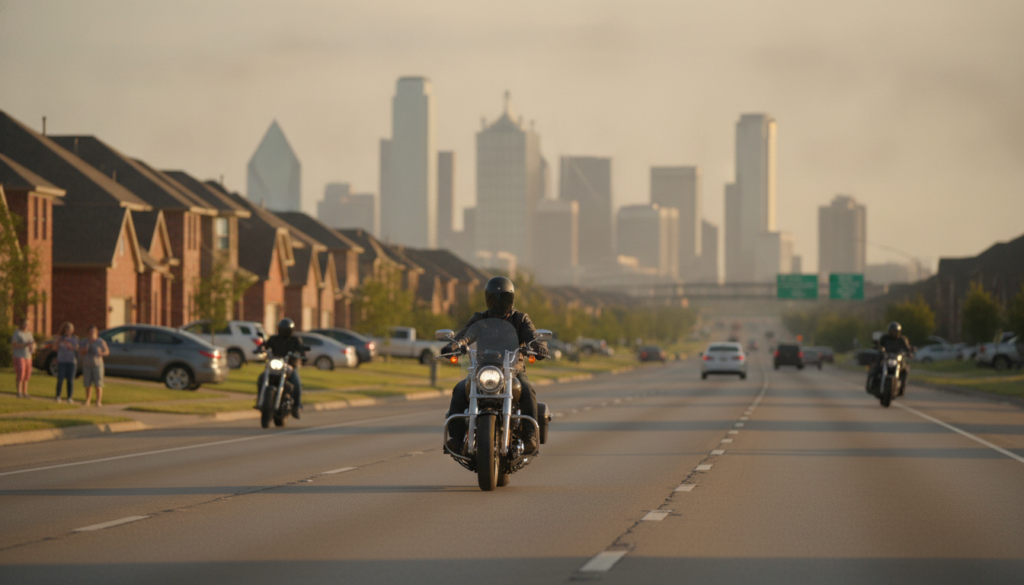
Dallas-Fort Worth is a great place to ride. Wide highways, mild winters, and a big riding community mean bikes are out on the road nearly all year. That much saddle time comes with risk, and here at DRH Insurance, we see the same coverage gaps show up over and over when riders ask us to look at their policies. Most of these problems are easy to avoid once you know what to look for.
This guide walks through the motorcycle insurance mistakes DFW riders make, why each one matters, and how to think through your options. We are not here to tell you exactly what to buy. Every rider is different. Every bike is different. Every budget is different. Our goal is to help you understand the choices so that when you sit down with a local agent, you already know the right questions to ask.
Why Motorcycle Insurance Mistakes DFW Riders Make Can Be So Costly
Before we get into specific pitfalls, it helps to understand why motorcycle coverage gaps hurt more than they might on other vehicles. When two cars collide, the metal around the drivers absorbs a lot of the impact. On a motorcycle, the rider is far more exposed. That physical vulnerability turns straight into higher medical costs when something goes wrong.
DFW traffic adds another layer. The Metroplex has some of the busiest interstates in the state, and distracted driving keeps getting worse. A rider can do everything right and still get taken out by someone glancing at a phone. When that happens, the strength of your insurance is what stands between you and a financial mess. That is why understanding the motorcycle insurance mistakes DFW riders make is not a dry technical exercise. It is about protecting your income, your savings, and your ability to get back on the road.
Think of the sections below as a checklist. You may find you have already dodged several of these. You may also spot a gap or two you did not know were there. Either way, you will be in a stronger spot the next time you review your policy.
Mistake 1: Carrying Only the State Minimum Liability Limits
Texas law requires drivers, including motorcyclists, to carry minimum liability coverage of 30/60/25. That breaks down to $30,000 for bodily injury per person, $60,000 for bodily injury per accident, and $25,000 for property damage. Those numbers are the legal floor. They are not a recommendation for what is actually enough.
Here is the problem. Motorcycle accidents tend to cause serious injuries, and serious injuries cause big bills. One emergency room trip, followed by surgery, physical therapy, and time off work, can blow past $30,000 fast. If you are found at fault and the other party’s injuries exceed your limits, you can be held personally responsible for the difference. That can mean garnished wages, liens, and years of stress.
Liability coverage is not there to protect your bike. It is there to protect everyone else when you cause an accident, and by extension it shields your own assets from a lawsuit. This is one of the more consequential motorcycle insurance mistakes DFW riders make, because minimum limits feel fine right up until the moment they are not.
How to think about it
When you review your coverage, look at what you actually have to lose. A homeowner with retirement savings and equity in a house has more to protect than a brand-new rider with few assets. Higher liability limits are one option worth discussing with an agent, and a lot of riders are surprised to see how their protection shifts as they move up from the state minimum. We can walk you through the tradeoffs so the decision fits your situation instead of a generic rule of thumb.
Mistake 2: Skipping Uninsured and Underinsured Motorist Coverage
Texas has a real share of drivers on the road with no insurance at all, and plenty more who carry only bare-minimum coverage. Picture it. An uninsured driver runs a light, hits you on your bike, and speeds off, or simply has nothing to pay with. Who covers your medical bills and your damaged motorcycle?
That is the job of uninsured and underinsured motorist coverage, usually shortened to UM/UIM. It helps pay for your medical expenses, lost wages, and damage to your motorcycle when the at-fault driver has no insurance or not enough to cover the harm they caused. For motorcyclists, who are so exposed in a crash, this coverage can be the difference between a manageable recovery and a financial disaster.
Leaving UM/UIM off a policy is one of the quieter motorcycle insurance mistakes DFW riders make, because nothing feels wrong until the day you need it. You do not choose who hits you. You cannot control whether that person bought insurance. UM/UIM gives you a safety net that does not depend on the other driver doing the right thing.
Why it matters more on two wheels
On a motorcycle, the injuries from getting hit by an uninsured driver are often severe. If your only recourse is to chase an uninsured driver in court, you may spend years and still recover nothing. UM/UIM keeps your recovery in the hands of a plan you actually control. When you sit down with a local agent, ask how UM/UIM works alongside your health insurance and your liability limits so you understand what each piece does.
Mistake 3: Forgetting to Insure Custom Parts and Accessories
Riders love to make their bikes their own. Custom paint, chrome, upgraded exhaust, aftermarket seats, saddlebags, GPS units, stereo systems, crash bars, specialty lighting. All of it adds personality and value. Here is what a lot of riders do not realize: a standard motorcycle policy usually includes only a limited amount of coverage for custom parts and equipment, often somewhere between $1,000 and $3,000.
If you have poured far more than that into modifications, a basic policy may not come close to covering your loss if the bike is stolen or badly damaged. That gap is one of the more expensive motorcycle insurance mistakes DFW riders make, especially in a community full of proud custom builds. Picture spending well over the built-in limit on aftermarket work, then having the bike stolen and learning your policy only pays back a fraction of what you put in.
What to do instead
Most insurers offer additional accessory coverage, sometimes called custom parts and equipment coverage, that lets you insure your modifications above the standard limit. The trick is to declare your additions and document them. Keep receipts, take clear photos, and make a simple list of what you added and what it cost. That paper trail makes it far easier to establish value and get a fair outcome if you ever file a claim.
- Photograph your bike from several angles after any major upgrade.
- Save receipts and invoices for parts and labor.
- Keep a running list of accessories with rough values.
- Tell your agent whenever you add something significant so your coverage stays current.
A quick conversation when you add expensive equipment prevents a painful surprise later. A little bookkeeping goes a long way here.
Mistake 4: Leaving Available Discounts on the Table
One of the most common motorcycle insurance mistakes DFW riders make has nothing to do with coverage gaps. It is simply not asking about the discounts they may qualify for. Insurers offer a range of ways riders can lower their premiums, and many people never bring them up because they do not know they exist.
We cannot quote specific numbers or promise savings, and every rider’s situation is different. What we can do is tell you the kinds of discounts that come up often so you know what to ask about. Depending on the insurer and your circumstances, these can include:
- Completing an approved motorcycle safety course, such as an MSF (Motorcycle Safety Foundation) course.
- Bundling your motorcycle policy with other coverage like auto, home, or renters insurance.
- Being an experienced, licensed rider with time in the saddle.
- Installing anti-theft devices or an alarm on your bike.
- Keeping a clean driving record.
- Storing your motorcycle in a garage rather than on the street.
Not every discount applies to every rider, and availability varies. The point is that these opportunities are worth raising. A safety course, for example, can make you a sharper rider and may qualify you for a discount at the same time. When you talk with a local agent, ask them to run through every discount you might be eligible for so nothing gets missed.
The bundling angle for DFW households
Plenty of DFW riders also own homes, drive cars, and rent apartments. Because DRH Insurance handles auto, home, condo, renters, life, and small business coverage alongside motorcycle policies, bundling is often worth exploring. Beyond possible discounts, keeping your policies in one place makes them easier to manage and review together, which helps you catch gaps across all your coverage instead of just on the bike.
Mistake 5: Assuming Your Auto Insurance Already Covers Your Motorcycle
This one comes up more than you might expect, and it is one of the riskiest motorcycle insurance mistakes DFW riders make. A lot of people assume that because they already carry auto insurance, their motorcycle is somehow covered under the same umbrella. It is not.
Car insurance policies do not extend to motorcycles. A motorcycle needs its own separate policy. The two are treated as different vehicles with different risk profiles, and your auto policy will not pay out for a motorcycle accident. If you ride without a motorcycle-specific policy, you are basically riding uninsured, which puts you at risk both legally and financially.
The danger here is the false sense of security. A rider who believes they are covered has no reason to shop for a policy, and they may only find the gap after a crash, when it is too late to fix. If you have a bike and you are not certain it has its own policy, that is worth confirming today. One phone call settles it.
What a dedicated policy brings
A motorcycle policy is built around the realities of riding. It can include liability, collision, comprehensive, UM/UIM, medical payments, accessory coverage, and more, all shaped around how motorcycles are used and the risks they face. Trying to force a bike under an auto policy would leave all of that out. If you own a motorcycle, treat its coverage as its own project, separate from the cars in your driveway.
Mistake 6: Insuring a Classic or Custom Bike at the Wrong Value
Standard policies often pay claims based on actual cash value, or ACV. That means if your bike is totaled, the payout reflects what the bike is worth at the time of the loss, after depreciation. For a typical late-model motorcycle, that is usually fair. For a classic, vintage, or heavily customized bike, ACV can badly undersell what the motorcycle is truly worth or what it would cost to replace.
Depreciation does not account for the years of restoration work on a vintage machine, or the tens of thousands of dollars a rider put into a custom build. Insuring one of these special bikes on a standard ACV basis is a subtle but painful entry on the list of motorcycle insurance mistakes DFW riders make, because you may not find the shortfall until you are trying to replace a bike you cannot replace.
Agreed value and stated value coverage
For unique motorcycles, ask your agent about agreed value or stated value coverage. With these approaches, you and the insurer settle on the bike’s value when the policy is written, rather than leaving it to a depreciation calculation after a loss. That way, if the worst happens and the bike is a total loss, the payout reflects the value you both agreed on up front. Documentation matters here too. Appraisals, restoration records, and detailed photos all help establish what your bike is worth. If you own something special, this is a conversation worth having before anything goes wrong, not after.
A Quick Look at How These Mistakes Add Up
It helps to see how these gaps stack. Consider a composite of riders we work with in the DFW area. This rider bought the state minimum liability, skipped UM/UIM to keep the policy lean, never mentioned the several thousand dollars of custom work on the bike, and assumed the whole thing was somehow tied to the family car policy. Every one of those decisions felt like a small money-saver at the time.
Now imagine that rider gets hit by an uninsured driver. The custom parts are damaged beyond the standard limit. There is no UM/UIM to help with medical bills or the bike. And because coverage was set at bare minimums, there is little cushion anywhere. What looked like a lean, efficient policy turns out to be a run of gaps lined up back to back. This is why we push riders to look at their coverage as a whole rather than one line item at a time.
The lesson is not that you need every possible coverage on every policy. It is that the motorcycle insurance mistakes DFW riders make tend to compound. Fixing even one or two of them meaningfully improves your position. Reviewing all of them together is how you build coverage that actually holds up when you need it.
How to Review Your Own Policy Without the Headache
You do not need to be an insurance expert to catch most of these issues. A short, honest look at your current policy can surface the biggest gaps in a few minutes. Here is a simple way to go through it.
- Find your liability limits and compare them to the 30/60/25 state minimum. Are you at the floor, or above it?
- Check whether UM/UIM is listed on your policy at all.
- Add up what you have spent on custom parts and accessories, then see what your policy allows for them.
- Confirm your motorcycle has its own policy, completely separate from any auto coverage.
- If your bike is classic, vintage, or custom, check whether it is insured on an actual cash value basis or an agreed value basis.
- Make a list of discounts you might qualify for that are not currently applied.
If any of those items give you pause, that is exactly the kind of thing worth flagging for a conversation. You do not have to solve it on your own. Understanding the motorcycle insurance mistakes DFW riders make really comes down to knowing which questions to ask so nothing important slips through.
Motorcycle Insurance Mistakes DFW Riders Can Avoid With a Simple Conversation
Almost every issue in this article traces back to the same root cause. A policy that was set up once and never revisited, or bought quickly without a full grasp of the options. Bikes change. Riders add accessories, buy new machines, move to a house with a garage, or finally take that safety course they meant to take. Life changes too, as your assets and responsibilities grow. Coverage that fit you three years ago may not fit you today.
That is why we treat a policy review as an ongoing habit rather than a one-time chore. The motorcycle insurance mistakes DFW riders make are not signs of carelessness. They are usually just the result of busy lives and policies that quietly drift out of step with reality. A periodic check-in keeps everything lined up.
At DRH Insurance Group, we work with riders across the Dallas-Fort Worth area on exactly these questions, alongside their auto, home, renters, life, and small business coverage. If any part of this guide raised a question about your own situation, we would be glad to walk through your options and help you understand what fits your riding, your bike, and your budget. There is no pressure and no obligation, just a straightforward conversation with a local team that knows the roads you ride. Reach out to a DRH Insurance agent whenever you are ready to take a closer look.
Frequently asked questions
What are the minimum motorcycle insurance requirements in Texas?
Texas requires liability coverage of 30/60/25, which is $30,000 for bodily injury per person, $60,000 per accident, and $25,000 for property damage. These are legal minimums, not necessarily what is adequate for your situation. Many riders choose to discuss higher limits with an agent, since motorcycle accident costs can climb quickly.
Does my car insurance cover my motorcycle in DFW?
No. Auto insurance policies do not extend to motorcycles, so your bike needs its own separate policy. Riding without motorcycle-specific coverage can leave you fully exposed both legally and financially, so it is worth confirming your bike has its own policy.
Are custom parts and accessories covered on a standard motorcycle policy?
Standard policies usually include only a limited amount of coverage for custom parts and equipment, often in the range of $1,000 to $3,000. If you have put more than that into modifications, you can ask about additional accessory coverage. Keeping photos and receipts helps document the value of your upgrades.
Why do motorcyclists need uninsured motorist coverage in Texas?
Texas has a notable number of uninsured and underinsured drivers on the road. Uninsured and underinsured motorist coverage helps pay for your medical bills, lost wages, and bike damage when an at-fault driver cannot cover the harm they caused. Because motorcyclists are so exposed in a crash, this coverage can be especially important.
How can I lower my motorcycle insurance premium?
Common opportunities include completing an approved motorcycle safety course, bundling policies, installing anti-theft devices, keeping a clean driving record, and garaging your bike. Availability varies by insurer and situation, and we cannot promise specific savings. The best step is to ask a local agent to review every discount you may qualify for.
Should a classic or custom motorcycle be insured differently?
Often, yes. Standard policies pay based on actual cash value, which factors in depreciation and may not reflect what a classic or custom bike is truly worth. For these bikes, you can ask about agreed value or stated value coverage, where you and the insurer settle on the value up front.