If you own a home anywhere in Dallas-Fort Worth, hail comes with the territory. North Texas sits in one of the busiest hail corridors in the country, and our hail season usually runs March through June. April and May are the worst of it. Some years the big storms slide past your neighborhood and you never think about it. Other years a single afternoon of golf-ball-sized hail leaves thousands of DFW roofs needing work all at once.
At DRH Insurance, we talk with local families every spring who are standing in the yard, squinting up at the roof, trying to figure out what to do next. The reassuring part is that the process is manageable once you know the steps. This guide walks through exactly how to handle a roof hail damage claim DFW homeowners face year after year, from the first few minutes after a storm all the way through the final repairs. We are here to explain, not to sell you anything. The more you understand before you ever pick up the phone, the smoother things tend to go.
What hail season looks like in DFW and why it matters
Knowing the local rhythm of storms helps you stay ready. In North Texas, warm, moist air off the Gulf runs into cooler air pushing down from the north and west. That collision builds the tall storms that drop hail. Most of the activity bunches up in spring, but we have seen damaging hail land well outside that window, so it pays to stay alert any time severe weather shows up in the forecast.
Why does the timing matter for a roof hail damage claim DFW residents might need to file? Two reasons. First, when a big storm hits, your insurance company and every decent roofer in the metroplex get slammed at the same time. Homeowners who document fast and report fast tend to move through the process before the long waits set in later in the season. Second, Texas policies generally expect prompt notification after a loss. The sooner you act, the easier it is to show the damage came from a specific recent storm instead of age or wear.
Hail is also sneaky. A storm can leave your roof looking fine from the ground while shingles up top are quietly bruised, cracked, or stripped of the granules that keep water out. That hidden damage can turn into leaks, rot, and interior problems months down the road. So even if you cannot spot anything from the driveway, a strong hailstorm is worth taking seriously.
Step 1: What to do right after a hail storm (safely)
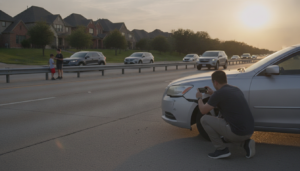
The moment the storm passes and it is genuinely safe to go outside, your job is to document and protect. Your job is not to climb onto a wet, slippery roof. We cannot say this strongly enough: stay off the roof after a storm. A fall is far more dangerous than any shingle. Leave the close-up inspection to a pro who has the training and gear to do it safely.
Here is what you can safely do from the ground and inside your home:
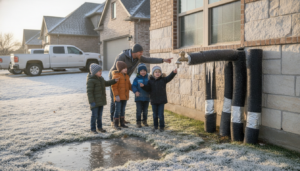
- Take clear, dated photos and videos. Shoot your roof from several angles using zoom, plus the gutters, downspouts, siding, windows, screens, fencing, outdoor AC units, and any dents in metal like your mailbox or garage door. Hail that dents metal almost certainly hit your roof too.
- Document the inside. Check ceilings, attic spaces, and the tops of interior walls for water stains or active drips. Photograph those too.
- Prevent further damage. If you have a broken window, a hole, or an obvious leak, cover it with a tarp or boards to keep water out. Texas policies expect you to take reasonable steps to limit additional loss.
- Save every receipt. If you buy tarps or boards or pay for emergency work, keep the receipts. Those temporary repair costs are often reimbursable as part of your claim.
- Do not throw anything away. Keep damaged items until your insurance company tells you it is fine to toss them. Those items can serve as evidence of the loss.
Think of this first step as building a time-stamped record of what the storm actually did. That record becomes the backbone of a clean roof hail damage claim DFW adjusters can process without a lot of back-and-forth.
Step 2: Get a professional roof inspection and documentation
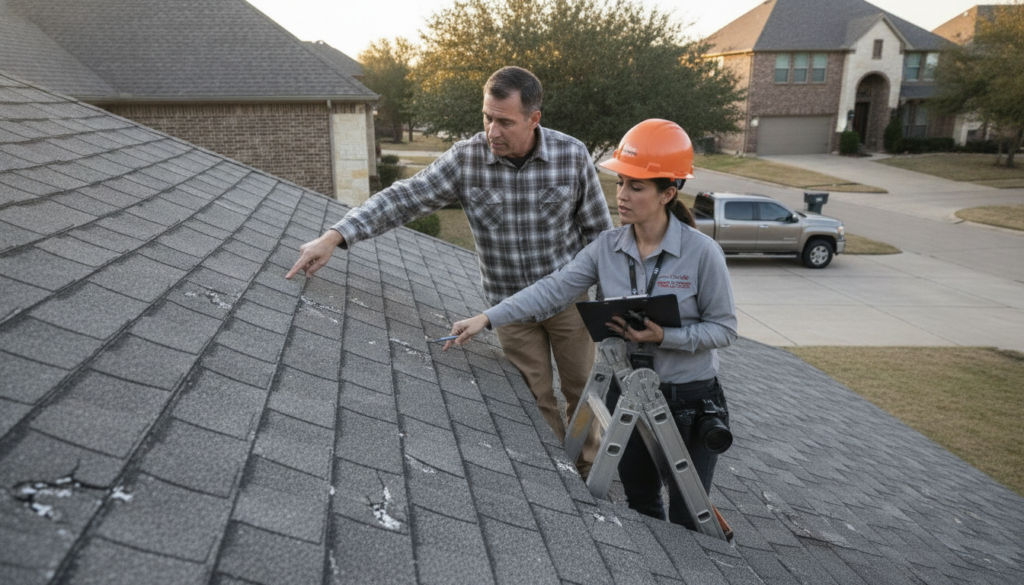
Because hail damage hides so well from the ground, we strongly suggest booking a free professional roof inspection with a qualified local roofing contractor. A reputable roofer can safely get up there, chalk-mark the hail hits, measure the test squares, and write up a detailed report with photos. That report helps a great deal when you file a roof hail damage claim DFW carriers expect to see backed by real evidence.
What is the inspector actually hunting for? A few telltale signs of hail impact:
- Granule loss. Hail knocks the protective granules off asphalt shingles. You may find those granules piling up in your gutters or at the base of your downspouts.
- Bruising or soft spots. A hail strike can bruise a shingle so it feels soft, like a bruise on an apple. That weakens the shingle even when you cannot see it from a distance.
- Cracked or fractured shingles. Bigger hail can split shingles outright.
- Dented flashing, vents, and gutters. Metal shows hail impact clearly and helps confirm how severe the storm was.
One quick word of caution here. The free inspection is genuinely helpful, but it is also the moment when storm-chasing contractors tend to show up with high-pressure pitches. We will cover how to spot those later. For now, just know that a trustworthy local roofer will inspect, document, and give you honest information without demanding you sign anything on the spot.
Step 3: Contact your insurance agency promptly
Once you have your photos and ideally a contractor’s inspection report in hand, the next step in any roof hail damage claim DFW homeowners file is to contact your insurance agency or carrier to report a possible claim. This is where having a local agency on your side pays off. We can walk you through what your specific policy covers, help you understand your deductible, and talk through whether filing makes sense for your situation.
Most homeowner policies in Texas expect prompt notification after a loss. Some policies allow one to two years to file a hail claim, but waiting is rarely a good idea. Acting quickly helps you avoid delays, keeps the timeline clean, and heads off disputes about whether the damage came from the recent storm or just general wear over time. The longer you wait, the harder it gets to prove when the damage happened.
When you report, be ready to share:
- The date of the storm.
- Your documentation: photos, videos, and any contractor report.
- A description of what you have seen, including any interior leaks.
- Receipts for any emergency repairs you have already made.
At this stage you are not committing to anything you cannot undo. You are opening the door so the process can begin. If you are not sure your situation rises to the level of a claim, that is exactly the kind of conversation we are here to have.
Step 4: Understand Texas wind and hail deductibles before you file
This is the part of a roof hail damage claim DFW homeowners get wrong most often, so it is worth slowing down. In Texas, wind and hail deductibles are usually percentage-based. Instead of a flat dollar amount, your deductible is a percentage of your dwelling coverage limit, often somewhere in the 1 percent to 5 percent range depending on your policy.
Here is how the math works with a simple example. Say your home carries a dwelling coverage limit of 300,000 dollars and your policy has a 2 percent wind and hail deductible. Two percent of 300,000 is 6,000 dollars. So you would cover the first 6,000 dollars of a covered hail loss before your coverage pays anything toward the rest. On that same home, a 1 percent deductible would put your out-of-pocket portion at 3,000 dollars. A 5 percent deductible would put it at 15,000 dollars.
A few important points about these percentage deductibles:
- They apply to wind events, not just big hail. This percentage deductible generally covers damage from any windstorm, including an ordinary thunderstorm, not only the headline hailstorms.
- They are tied to your dwelling limit, not your repair cost. The math is based on how much your home is insured for, so as your dwelling coverage climbs over the years, your dollar deductible climbs with it.
- You should know yours before a storm hits. The worst time to learn your deductible is while you are already staring at a damaged roof. We encourage every homeowner to pull out the declarations page and confirm the wind and hail deductible now, before hail season peaks.
Knowing your deductible lets you make a clear-eyed call. If your documented damage runs well above your deductible, filing a roof hail damage claim DFW carriers can process may make a lot of sense. If the damage looks minor and close to your deductible, talk it over first. We are always glad to help you think it through, with no pressure either way.
Step 5: The adjuster visit for your roof hail damage claim DFW
After you file, your insurance company assigns an adjuster to inspect the damage in person. The adjuster climbs the roof, assesses the hail impact, and builds an estimate of the covered loss. This visit matters a lot in your roof hail damage claim DFW process, so a little prep goes a long way.
Here is something many homeowners do not realize: under Texas law, you have the right to have a licensed contractor present during the adjuster’s inspection. Having your roofer there can be genuinely valuable. The two can walk the roof together, point out damage, and reach a shared understanding of what needs repair or replacement. That cuts down the odds of a dispute later over what the storm actually did.
To get ready for the adjuster visit:
- Have all your documentation organized and ready to hand over: photos, videos, your contractor’s report, and receipts.
- Walk the adjuster through everything you noticed, including interior stains and dented metal that confirm how hard the hail hit.
- Coordinate the timing so your contractor can be there if you choose to have them present.
- Take notes during the visit, including the adjuster’s name and what they flagged.
After the inspection, the adjuster produces an estimate of the damage. That estimate becomes the basis for your settlement, which brings us to the next step.
Step 6: Review the settlement and manage repairs
Understanding how settlements get paid saves a lot of confusion. Many homeowners policies that carry Replacement Cost Value, or RCV, coverage pay a hail claim in two parts.
The first payment is the Actual Cash Value, or ACV. That is the cost to repair or replace the roof minus depreciation, which accounts for the age and condition of the roof before the storm. In plain terms, an older roof has lost some value through normal wear, and the ACV check reflects that.
The second payment is the recoverable depreciation. After the repairs are done and you submit an invoice showing the work was completed, your insurer releases this second portion. Put together, the ACV check plus the recoverable depreciation, minus your deductible, is how an RCV policy funds a full roof replacement. Keep in mind that not every policy includes RCV coverage. Some are written on an ACV basis, which pays the depreciated value and does not include a second recoverable depreciation payment. This is exactly the kind of policy detail worth confirming before a storm, and we are glad to review yours with you.
Once you have the adjuster’s estimate, here is how to handle the repair side of your roof hail damage claim DFW process:
- Get multiple bids from reputable local contractors. Comparing bids helps you understand the fair scope and cost of the work.
- Compare the bids to the adjuster’s estimate. If a contractor finds damage or code-required work the adjuster missed, that can often be handled through a supplement to the claim. Your contractor and your insurer can talk directly about those items.
- Confirm the contractor is licensed, insured, and local. You want someone who knows Texas building codes, will still be around if a problem crops up next year, and carries their own liability and workers compensation coverage.
- Make sure the work matches the scope. The repairs should cover everything the storm damaged, not a watered-down version that saves a contractor money.
A roof replacement is one of the biggest repairs most homeowners ever deal with. Taking the time to understand the two-part payment structure and to vet your contractor protects both your home and your wallet.
Step 7: Avoid contractor scams after a DFW hail storm
Every spring, after a big storm rolls through, DFW neighborhoods fill up with out-of-state contractors sometimes called storm chasers. Plenty are legitimate. But the metroplex also draws high-pressure operators who follow the storms, collect the money, do rushed or incomplete work, and vanish before anyone notices the problems. Protecting yourself from these outfits is one of the most important parts of a successful roof hail damage claim DFW homeowners file.
Here are the red flags we warn our neighbors about:
- Offers to waive or absorb your deductible. This is a big one. Under Texas law, specifically House Bill 2102, it is illegal for a contractor to waive your insurance deductible. Your insurance company may require proof that you actually paid your deductible. Any contractor who promises to make your deductible disappear is pushing you toward something illegal, and that alone tells you to walk away.
- High-pressure sales tactics. Legitimate roofers do not insist you sign today or lose the deal forever. If someone is rushing you, slow down.
- Large upfront payments. Do not pay in full before any work is done. A reasonable deposit is normal. Paying for the whole job upfront is a risk.
- Contracts with blank spaces. Never sign a document with empty fields a contractor can fill in later. Every price, scope item, and date should be filled in before your signature goes on the page.
- No local footprint. Check references, confirm a physical local address, and look the company up with the Better Business Bureau. A roofer who lives and works here has a reputation to protect.
Take your time choosing a contractor. The storm created urgency, but that urgency should never push you into a bad contract. A trustworthy, established local roofer will respect your need to compare bids, read the fine print, and coordinate with your insurer.
A realistic timeline for your roof hail damage claim DFW
Homeowners often ask us how long all of this takes. Every claim is different, and we cannot promise any specific timeline or outcome, but here is a general sense of how the pieces usually fall into place for a roof hail damage claim DFW families go through.
Consider a composite example drawn from the kinds of situations we see across the metroplex. Picture a family in a suburban DFW home after an early-May hailstorm. On day one, as soon as it is safe, they photograph the roof, gutters, dented AC unit, and a cracked skylight, then tarp the skylight to stop water from getting in. Within the first few days, they book a free inspection with a licensed local roofer, who documents clear granule loss and bruising and writes up a report. Shortly after, they call their agency to report the claim and confirm their wind and hail deductible.
Over the next few weeks, the carrier assigns an adjuster, the family schedules their roofer to be there for the inspection, and an estimate comes back. Once they understand the settlement structure, including any ACV payment and recoverable depreciation, the family gathers bids, picks their trusted local roofer, and the work is scheduled around the roofer’s storm-season backlog. After repairs wrap up and the invoice goes in, the recoverable depreciation portion is released. The whole process, from storm to finished roof, commonly runs several weeks to a few months depending on how busy contractors and adjusters are after a major event.
The two biggest things that speed it up are early documentation and prompt reporting. The two biggest things that drag it out are waiting too long to file and getting tangled up with an unreliable contractor. Everything in this guide is built to land you on the fast, clean side of that equation.
Preparing before the next storm
The best roof hail damage claim DFW homeowners ever file is the one they were fully prepared for before the hail even fell. A little prep during the quiet months makes the stressful moments far easier.
- Know your wind and hail deductible. Pull your declarations page and confirm the percentage and the dollar figure it works out to for your home.
- Know whether you have RCV or ACV coverage. This single detail changes how a settlement gets paid, and it is worth reviewing with your agent.
- Keep a baseline record of your roof. Photos of your roof in good shape give you a clear before-and-after if a storm hits.
- Build a documentation habit. Save receipts for any roof maintenance, and keep a folder, digital or physical, for home records.
- Have a trusted local roofer in mind. Lining up a reputable, established contractor before the rush means you are not scrambling when every roof on the block needs attention.
None of this takes much time. A single afternoon reviewing your policy and photographing your home can save you a lot of stress later.
Where the Texas Department of Insurance fits in
For extra questions or help during the claims process, the Texas Department of Insurance, or TDI, is a genuinely useful public resource. TDI publishes consumer guidance on storm claims, offers help if you hit problems during a claim, and explains your rights as a Texas policyholder. If you ever feel stuck or confused during a roof hail damage claim DFW process, TDI is a solid, neutral place to turn for information.
Between your documentation, a reputable local roofer, your insurance carrier, and resources like TDI, you have a strong support system for working through hail damage. The trick is to tackle it one step at a time instead of all at once.
Let us help you think it through
Hail is one of the few things in North Texas you can count on, and a roof hail damage claim DFW homeowners file does not have to be overwhelming. When you document early, understand your deductible, report promptly, prepare for the adjuster, read your settlement carefully, and steer clear of storm-chaser scams, you put yourself in a strong spot at every step.
At DRH Insurance, our team lives and works in this community, and we see what hail season does to local homes every year. If you want to review your current policy, understand your wind and hail deductible, or just talk through your options before the next storm rolls in, we are here for that conversation. No pressure and no hard sell, just straight answers from neighbors who want you protected. Reach out to our team anytime, and we will walk through it together.
Frequently asked questions
How long do I have to file a roof hail damage claim in DFW?
Most Texas homeowner policies expect prompt notification after a loss. Some policies allow one to two years to file a hail claim, but filing quickly is strongly recommended. Acting fast helps you avoid delays and prevents disputes about when the damage actually happened. If you are unsure of your specific deadline, check your policy or ask your local agent.
How is my wind and hail deductible calculated in Texas?
In Texas, wind and hail deductibles are usually a percentage of your dwelling coverage limit, often between 1 percent and 5 percent, rather than a flat dollar amount. For example, a 2 percent deductible on a home insured for 300,000 dollars means you pay the first 6,000 dollars of a covered loss. Review your declarations page to confirm your exact percentage before storm season.
Can a roofing contractor legally waive my insurance deductible in Texas?
No. Under Texas House Bill 2102, it is illegal for a contractor to waive your insurance deductible, and your insurance company may require proof that you actually paid it. Any contractor who offers to make your deductible disappear is a red flag, and you should walk away from that offer.
Should I get my own roof inspection before filing a claim?
Yes. A free professional inspection from a qualified local roofer is a smart move because hail damage like granule loss and bruising is often hard to see from the ground. A reputable contractor can safely inspect the roof, mark the damage, and provide a detailed written report with photos. That documentation strengthens your claim and helps the process go more smoothly.
Why does my insurance pay a hail claim in two separate checks?
Many policies with Replacement Cost Value coverage pay first for the Actual Cash Value, which subtracts depreciation, and then release the recoverable depreciation after repairs are finished and you submit an invoice. Together, those two payments minus your deductible fund the full repair. Some policies are written on an Actual Cash Value basis instead, so it is worth confirming which type you have.
Is it safe to climb on my roof to check for hail damage after a storm?
No. You should not climb on your roof after a storm, especially while it is wet or you lack proper equipment. A fall is far more dangerous than any roof damage. Document what you can from the ground and inside your home, then let a trained, licensed local roofer handle the up-close inspection safely.
Sources
- Texas Hail Damage and Home Insurance: What Is Covered & How It Works – Kin Insurance
- TX Hail Damage Roof Claim: A Homeowner’s Guide
- Texas Hail Damage Roof Insurance Claims Guide – Ranch Hand Construction
- How to Find a Trustworthy Roofer After a DFW Hail Storm – Infinite Roofing GC LLC
- Wind/Hail Percentage Deductibles in Texas: How the Math Actually Works
- Understanding Your Hail Deductible in Texas: A 2026 Guide for DFW Homeowners