North Texas is one of the better places in the country to keep a boat, and most owners around here already know it. Lake Lewisville, Grapevine Lake, Ray Roberts, Joe Pool, Eagle Mountain, Cedar Creek, Possum Kingdom, and Lake Texoma up on the Oklahoma line are all a short drive from the Metroplex. So the question our team hears most from local boat owners is a simple one. How much does it cost to insure this thing?
It’s a fair question, but an honest answer takes more than a single number. Boat insurance is priced on a mix of factors, and two boats parked side by side at the same marina can end up with very different premiums. This guide walks through what actually drives boat insurance cost in Dallas-Fort Worth, what coverage options exist, where Texas rules come into play, and the practical steps that tend to help owners find a rate they feel good about. We’re writing this to explain how it works, not to talk you into anything.
What Goes Into Boat Insurance Cost in Dallas-Fort Worth
Start with the honest, unsatisfying truth. There’s no flat rate for boat insurance. Across Texas, annual premiums can range from roughly $100 for a bare-bones liability policy on a small boat to well over $2,500 a year for larger, higher-value, or high-performance vessels. Nationally, a lot of everyday recreational policies land somewhere in the few-hundred-dollars-a-year neighborhood, and Texas often runs on the higher end of that national picture because of our long boating season and, for owners closer to the coast, hurricane exposure.
Those are ranges you’ll see cited around the industry. They are not quotes. We’re not going to pretend to price your specific boat in a blog post, because doing that honestly means knowing the details of your boat, how you use it, and the coverage you actually want. What we can do is explain which of those details move the number up or down, so when you get a quote it makes sense instead of feeling like a coin flip.
Understanding boat insurance cost in Dallas-Fort Worth comes down to understanding risk. An insurer is trying to estimate how likely it is that they’ll have to pay a claim, and how big that claim might be. Everything below is a different angle on that same question.
The short version: your premium reflects what you own, where and how you use it, how much protection you want, and who is at the helm. Change any one of those and the price can shift.
Boat Type and Size: The Biggest Lever on Your Rate
The single largest factor in most quotes is the boat itself. Larger, faster, and more valuable boats generally cost more to insure. They cost more to repair or replace, and more power usually means more risk on the water.
Here’s a rough sense of how different boat types tend to stack up in Texas, again as general ranges and not promises:
- Small inland fishing boats: often on the lower end, commonly cited around $100 to $500 per year. These are the bass boats and jon boats you see all over DFW lakes.
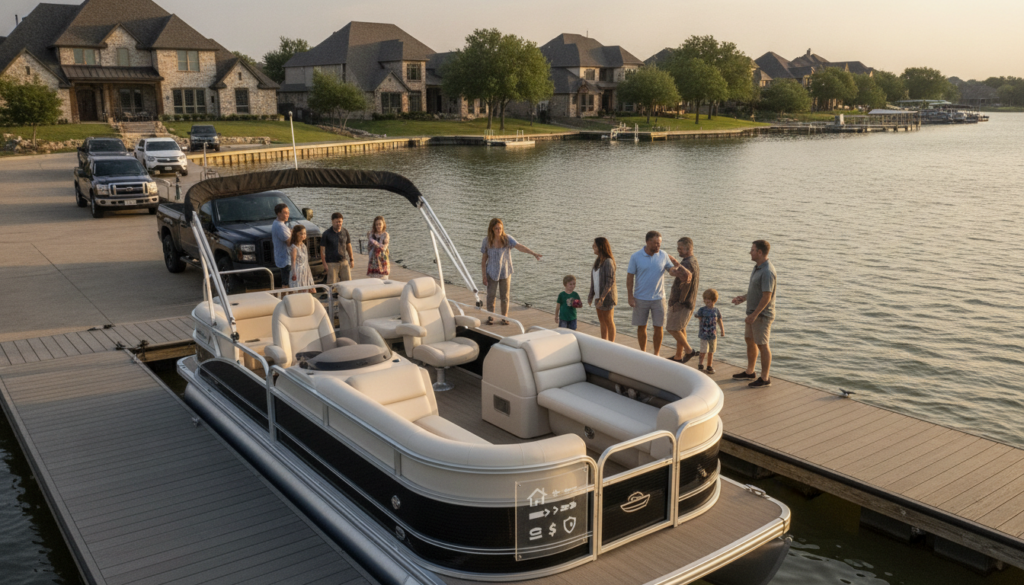
- Pontoon boats: a popular family choice on lakes like Grapevine and Lewisville, frequently landing somewhere around $300 to $1,000 per year depending on value and features.
- Larger offshore or high-value fishing boats: can run considerably higher, often $800 to $2,500 or more annually.
- High-performance speedboats and larger cruisers: tend to sit at the top of the range because of horsepower, value, and repair costs.
A few specific attributes of the boat matter here. Horsepower is a big one. A boat capable of high speeds is treated differently than a modest pontoon. Hull design and material factor in too. And the overall value of the boat is central, because a comprehensive policy is partly protecting that value against theft, storm, fire, and accident.
This is why boat insurance cost in Dallas-Fort Worth varies so widely between neighbors. The retiree with an aluminum fishing boat trailered to Ray Roberts a few weekends a year is a very different risk than the family with a large wakeboarding boat that lives in a slip all summer. Neither is wrong. They’re just priced according to what they are.
Age and Condition Also Play a Part
Newer, more expensive boats typically carry higher premiums, simply because there’s more value to protect. Older boats are interesting. On one hand, age can mean more wear and tear, which insurers consider. On the other, a well-maintained older vessel with a documented service history can sometimes be viewed more favorably. If you’ve kept up with maintenance and can show it, that’s worth mentioning when you shop.
How Location and Water Use Shape Boat Insurance Cost in Dallas-Fort Worth
Where your boat lives and where you actually take it are major pieces of the pricing puzzle. This is genuinely good news for a lot of DFW owners, because inland lake boating is generally viewed as lower-risk than coastal or offshore use.
Insurers pay close attention to what’s called your navigation area, meaning the type of water your boat operates on. Policies distinguish between inland lakes, bays, coastal waters, the Gulf, and offshore. Broader and riskier navigation areas typically cost more. A boat used only on North Texas lakes generally represents a different risk than one running out into the Gulf, where storms, saltwater exposure, and theft push premiums higher.
For that reason, boat insurance cost in Dallas-Fort Worth can look more favorable than the same boat insured for heavy coastal use. That doesn’t mean inland boating is risk-free. Storms roll across the Metroplex, hail is a real thing, and lakes get crowded on summer weekends. But the overall exposure profile is often gentler than the Gulf Coast.
Storage and Where the Boat Sleeps
How and where you store the boat matters too. A few patterns tend to help:
- Boats kept in secure locations such as dry storage, gated marinas, or a locked garage or covered storage at home may be viewed more favorably than those left out in the open.
- Anti-theft devices, GPS tracking, and security systems can factor positively into your risk profile.
- Seasonal use versus year-round use matters. A boat safely stored during the off-season may be looked at differently than one in the water twelve months a year.
None of this is about jumping through hoops. Storage and security simply speak to the likelihood of theft and weather damage, and those are two of the things a policy is designed to cover.
Coverage Choices and Deductibles Behind Your Boat Insurance Cost in Dallas-Fort Worth
Here’s where you actually have some control. Two identical boats can carry very different premiums based purely on the coverage the owner chose. The type and amount of coverage you select directly affects what you pay.
At a high level, boat policies fall along a spectrum:
- Liability-only coverage is generally the least expensive option. In Texas, liability-only boat policies are sometimes cited as starting quite low. Liability is designed to help with damage or injury you might cause to others or their property. It doesn’t pay to repair or replace your own boat.
- Comprehensive coverage adds protection for your own boat against things like theft, storm, fire, and accidents. It costs more because it’s doing more.
Beyond that core decision, there are additional coverages owners can consider, each of which adds to the premium:
- Wreckage removal, which can help cover the cost of removing a sunken or damaged boat.
- Fuel spill liability.
- Watersports coverage for activities like tubing, wakeboarding, and water skiing.
- Coverage for fishing equipment, electronics, and other gear.
- Coverage for trailers, personal effects, and towing or on-water assistance.
Your deductible is another lever. Choosing a higher deductible generally lowers your premium, but it also means you’d pay more out of pocket if you file a claim. A lower deductible does the reverse. There’s no universally correct answer. It depends on your budget and how much risk you’re comfortable carrying yourself. This is exactly the kind of trade-off worth talking through with an agent instead of guessing at.
When people ask us about boat insurance cost in Dallas-Fort Worth, this is often where the real conversation happens. The boat is what it is, but the coverage design is where your priorities and your budget meet. The goal isn’t the lowest number. It’s a policy that would actually do what you expect it to do on your worst day on the water.
The Operator: How You and Your History Factor In
Insurers don’t just look at the boat. They look at who’s operating it. Several operator-specific factors come into play:
- Boating experience. More time at the helm is generally viewed favorably.
- Driving and boating history. A clean record helps. A history of claims or incidents can lead to higher costs.
- Safety training. Completing a state-approved boating safety course is one of the more accessible things a boater can do, and it’s often looked upon favorably.
- Claims history. Like most insurance, prior claims can affect what you pay going forward.
The encouraging part is that some of these are things you can influence. Taking a recognized boating safety course, keeping a clean record, and operating responsibly are all within your control, and they tend to line up with being a safer boater anyway. That overlap between safe habits and better pricing is one of the nicer features of how boat insurance cost in Dallas-Fort Worth is calculated.
Is Boat Insurance Required in Texas?
This is one of the most common questions we get, and the answer surprises some people. For most recreational boat owners, boat insurance is not legally required in Texas. Unlike auto insurance, the state doesn’t mandate it for the average recreational vessel.
That said, “not legally required” is very different from “not needed.” There are a few situations where you’ll almost certainly need coverage:
- If your boat is financed, lenders typically require full coverage until the loan is paid off, to protect their investment.
- If you keep your boat at a marina, many marinas require liability insurance as a condition of docking.
There’s also a common misunderstanding worth clearing up. A lot of owners assume their homeowners insurance covers their boat. Homeowners policies usually offer only very limited coverage for watercraft, often for small boats and small motors, and they generally don’t provide comprehensive boat liability or the kind of on-water protection a dedicated boat policy offers. Leaning on a homeowners policy for a real boat can leave big gaps you wouldn’t want to discover after an incident. If you’re not sure what your current homeowners policy does and doesn’t cover for your boat, that’s a great thing to ask us about.
So while the state may not force you to carry it, most DFW boat owners we talk to decide the financial protection is well worth having. A single accident, theft, or storm can turn into a serious expense, and boat insurance exists to keep that from becoming your problem alone.
Ways DFW Boat Owners May Be Able to Lower Their Costs
Nobody wants to overpay. We can’t promise specific savings, but there are several well-established ways to help reduce boat insurance cost in Dallas-Fort Worth. Whether each one applies to you depends on your situation and the carrier, so treat this as a checklist of things worth asking about rather than guaranteed discounts.
- Bundling policies. Insuring your boat alongside your auto, home, or other policies with the same company can sometimes lead to a better overall rate. If you already have your home and auto with us, it’s worth seeing how a boat policy fits in.
- Completing a boating safety course. State-approved safety courses are frequently rewarded, and they make you a better boater in the process.
- Maintaining a clean record. A history free of claims and incidents supports a better rate over time.
- Being the original owner. Some carriers view original ownership favorably.
- Paying in full. Paying your premium in one payment rather than in installments can sometimes reduce the total cost.
- Safety and security equipment. Items like fire extinguishers, GPS tracking, and anti-theft devices can factor positively.
- Choosing a higher deductible. As mentioned earlier, this lowers the premium in exchange for more out-of-pocket cost at claim time, so it’s a trade-off, not free money.
- Seasonal or lay-up considerations. If your boat is stored securely during the off-season, that may be reflected in how your policy is structured.
The best approach is usually not to chase a single discount but to look at the whole picture. An agent who knows the local market can help you see which of these levers actually apply to your boat and your habits, so you’re not leaving anything obvious on the table.
A Realistic Look at Boat Insurance Cost in Dallas-Fort Worth for Different Owners
To make this concrete, here are a few composite examples. These are illustrative profiles based on the kinds of boat owners our team works with around the Metroplex, not real individual clients, and the ranges are general industry figures rather than quotes.
The weekend lake fisher
Picture an owner with a modest aluminum fishing boat they trailer to Lake Ray Roberts a handful of weekends a year, storing it in the garage otherwise. Because the boat is small, lower in value, used seasonally on inland water, and stored securely, this owner tends to sit toward the lower end of the range, potentially in the low hundreds of dollars per year for a solid policy. If they carry only liability, it can be lower still, though that leaves their own boat unprotected.
The family pontoon crowd
Now picture a family with a pontoon boat that lives in a slip at a Grapevine Lake marina all summer, used most weekends for cruising and tubing with the kids. The higher value, the slip storage, the frequent use, and the watersports activity all nudge the premium up compared to the fishing boat, landing somewhere in the mid-range for many families. Adding watersports coverage is common here given how the boat is used.
The performance boat owner
Finally, picture someone with a fast, higher-value boat kept in the water most of the year. Higher horsepower, higher value, and heavier use combine to push this owner toward the upper end of the range, and comprehensive coverage with higher liability limits is a common conversation for boats like this.
The point of these composites is simple. Boat insurance cost in Dallas-Fort Worth depends heavily on who you are as an owner and how you actually use the boat. Two people can read this article and walk away with very different, and equally reasonable, expectations.
How to Get an Accurate Read on Your Own Boat Insurance Cost in Dallas-Fort Worth
Ranges only get you so far. Here’s what actually gets you to a real, personalized number. When you’re ready to shop, it helps to have this information handy:
- The make, model, year, and length of your boat.
- The engine type and horsepower.
- The approximate value, and whether it’s financed.
- How and where you store it (garage, driveway, marina slip, dry storage).
- Where you primarily use it (which lakes, and whether you ever venture to coastal waters).
- How often you use it, and whether it’s seasonal or year-round.
- Your boating experience and any safety courses you’ve completed.
- The kind of coverage and deductible you have in mind, and any add-ons you care about like watersports or fishing equipment.
With those details, an agent can give you an actual quote rather than a guess, and can walk you through why the number is what it is. That transparency is the whole idea. You should never feel like your premium is a black box.
One more thing worth saying plainly. The cheapest policy and the right policy aren’t always the same thing. It’s easy to shave the number down by cutting coverage or raising deductibles, but that only feels good until the day you need to file a claim. A good conversation about boat insurance cost in Dallas-Fort Worth balances what you pay against what you’d actually get back, and that balance looks different for every owner.
Why It Pays to Work With a Local Team
North Texas boating has its own rhythm. We know these lakes, we know how DFW weather behaves, and we know the questions local owners run into, from marina liability requirements to how homeowners coverage falls short for a real boat. That local context helps when you’re trying to make sense of your options.
At DRH Insurance Group, our team enjoys walking boat owners through this stuff without jargon and without pressure. Maybe you already have a boat and want to make sure your coverage still fits. Maybe you just bought something new. Maybe you’re simply researching before a first purchase. Either way, we’re happy to talk it through and help you understand the choices in front of you. If you’d like a real, personalized look at boat insurance cost in Dallas-Fort Worth for your specific situation, reach out to our local team and we’ll help you sort out the options that make sense for you and your time on the water.
Frequently asked questions
How much does boat insurance cost in Dallas-Fort Worth?
There’s no single price. Rates depend on your boat’s type, size, value, how and where you use it, your coverage choices, and your boating history. Across Texas, annual premiums can range from around $100 for basic liability on a small boat to well over $2,500 for larger or high-performance vessels. The best way to know your cost is to get a personalized quote based on your specific boat and how you use it.
Is boat insurance required in Texas?
For most recreational boat owners, boat insurance is not legally required in Texas. Lenders typically require full coverage if your boat is financed, though, and many marinas require liability insurance to dock there. Even when it isn’t mandatory, coverage is widely recommended to protect against accidents, theft, and storm damage.
Does my homeowners insurance cover my boat?
Homeowners policies usually provide only very limited coverage for watercraft, often just for small boats and small motors, and generally don’t include comprehensive boat liability or on-water protection. Leaning on a homeowners policy for a real boat can leave significant gaps. It’s worth asking an agent to review exactly what your current policy does and doesn’t cover.
What factors affect boat insurance cost the most in DFW?
The biggest factors are usually the boat’s type, size, horsepower, and value, followed by where you store and use it, the coverage and deductible you choose, and your boating experience and claims history. Inland lake use in North Texas is often viewed more favorably than coastal or Gulf use. Changing any of these can move your premium up or down.
How can I lower my boat insurance cost in Dallas-Fort Worth?
Common approaches include bundling your boat with other policies, completing a state-approved boating safety course, maintaining a clean record, storing your boat securely, and adding safety equipment like GPS or fire extinguishers. Choosing a higher deductible can also lower the premium, though it means more out-of-pocket cost at claim time. Which options apply depends on your situation, so it helps to review them with an agent.
Do I need boat insurance to keep my boat at a DFW marina?
Many marinas require liability insurance as a condition of docking your boat there, even though the state doesn’t require it. Requirements vary by marina, so check with yours directly. An agent can help you set up a policy that meets both marina and lender requirements.
Sources
- Current time information in Runnels County, US.
- Current time information in Dallas, TX, US.
- How Much Does Boat Insurance Cost? A Complete Guide – GEICO
- Boat Insurance Cost in Texas (2026): Rates by Boat Type
- How Much Is Boat Insurance? – Progressive
- How Much Does Boat Insurance Cost (and How to Choose it)