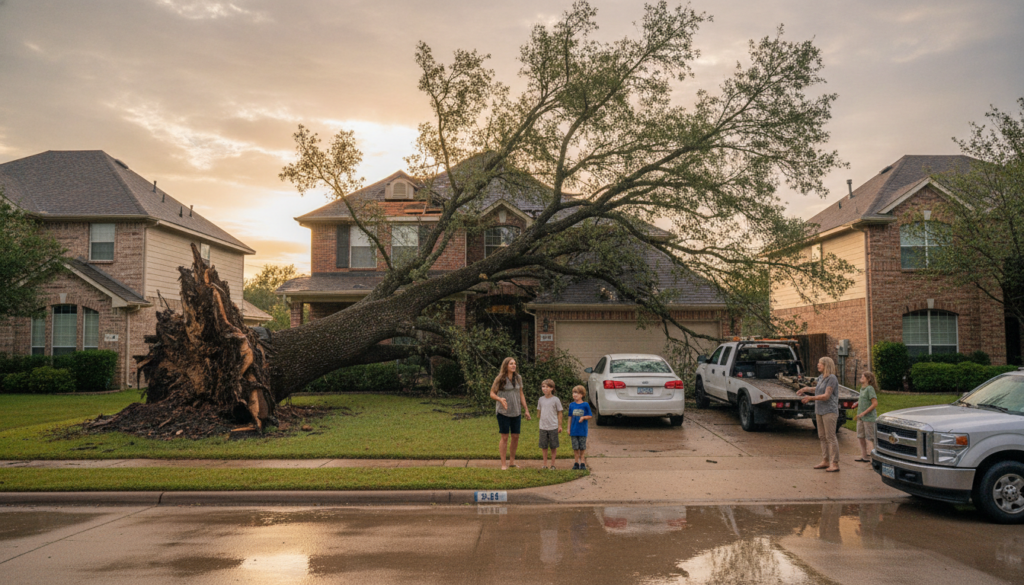
A neighbor’s healthy tree that falls on your Dallas home during a storm is usually covered by your own homeowner’s policy, not theirs. That surprises most people, so let’s back up and set the scene. It’s a spring evening in Dallas-Fort Worth. The sky turns that odd green-gray color we all know, the wind kicks up, and inside twenty minutes a line of storms rolls through with 60-mile-per-hour gusts. You ride it out. Then you step outside to survey the damage and there it is: the big post oak that stood in your neighbor’s backyard for decades is now lying across your roof, branches poking through the shingles and a limb draped over your fence.
Right after “is everyone okay,” most people think the same thing: it’s their tree, so they pay, right? It feels obvious. The Texas answer has more layers than homeowners expect, and getting it wrong can cost you money out of pocket. This is one of the questions we hear most at DRH Insurance Group, and the phrase people search for is some version of “neighbor’s tree fell on my house insurance DFW.” So let’s walk through how it actually works, with a realistic example, so you know what to expect before you ever pick up the phone.
The short answer to “neighbor’s tree fell on my house insurance DFW”
Start with the part that surprises people most. In most storm situations here in North Texas, when your neighbor’s healthy tree falls on your house because of wind, hail, or lightning, your own homeowner’s insurance is generally the policy that responds, not your neighbor’s.
That feels backwards. It was their tree, rooted in their yard, and yet you’re the one filing a claim. The reason comes down to a legal idea insurers often call an “act of God” or an act of nature. When a storm knocks down a healthy tree, nobody caused it. There was no negligence, no carelessness, no decision that brought the tree down. It was just the weather doing what North Texas weather does.
Because no one is at fault, the damage falls to the policy covering the property that got hit, which is yours. So when people type “neighbor’s tree fell on my house insurance DFW” into a search bar hoping to learn how to make the neighbor pay, the more useful takeaway is usually this: understand your own homeowner’s policy first, because it’s often the one doing the heavy lifting.
This isn’t a loophole or a trick. It’s how the system is designed to run smoothly. Your carrier pays for your property damage quickly instead of everyone waiting months to argue about blame. There is one important exception, though, and it can flip the whole situation. We’ll get to negligence in a minute.
A DFW case example: the Fort Worth oak that changed everything
Let’s make this concrete with a story that mirrors what we see across Tarrant and Dallas counties every storm season.
Picture a homeowner we’ll call Marcus. He lives in a 1990s brick home in Fort Worth. His neighbor has a large, mature oak near the shared fence line. One April night, a severe thunderstorm with strong straight-line winds moves through. The oak snaps about eight feet up the trunk and drops straight onto Marcus’s roof, punching a hole into his attic and crushing part of his back patio cover.
Here’s how it plays out in the two most common versions of this story.
Version one: the tree was healthy
The oak was leafy, green, and structurally sound before the storm. An arborist would have called it a healthy tree. Here, this is an act of nature. Marcus files a claim on his own homeowner’s policy. His policy generally covers the structural repairs, the roof, the attic, the patio cover, and, importantly, removing the portion of the tree sitting on his house. His neighbor is typically not held responsible, because the neighbor did nothing wrong. The tree was fine until an unusual storm brought it down.
Version two: the tree was already dead
Now change one detail. Suppose that oak had been visibly dead for two years. The bark was peeling off, there were no leaves in summer, mushrooms grew at the base, and the whole thing leaned noticeably toward Marcus’s house. Marcus had even texted his neighbor twice asking him to have it removed, and the neighbor never did anything.
This is where negligence enters, and it can shift responsibility toward the neighbor. If a tree was obviously hazardous, and the owner knew or reasonably should have known and failed to act, that changes the analysis. In this version, Marcus’s documentation, the text messages and any photos of the dead tree, becomes worth a lot. His own insurer may still step in to repair his home quickly, but there may be an opportunity for his carrier to pursue the neighbor’s insurance for reimbursement, a process called subrogation.
The lesson from Marcus’s two scenarios is the whole heart of the “neighbor’s tree fell on my house insurance DFW” question: the cause and the condition of the tree matter far more than whose property it grew on.
How negligence changes who pays after a tree falls
Since negligence is the factor that can move the bill from your policy to your neighbor’s, it’s worth understanding what it takes to establish. This isn’t something you or your neighbor decides in a driveway conversation. It’s a legal standard, and it generally requires evidence.
In broad terms, a neighbor may be considered negligent if all of the following are true:
- The tree was in a clearly hazardous condition before it fell, meaning it was dead, diseased, rotting, or dangerously leaning.
- The condition was visible or otherwise knowable, so the owner knew or reasonably should have known about it.
- The owner had a reasonable chance to address it and did not.
- That failure to act is what allowed the tree to fall and cause damage.
Notice how high that bar sits compared with a healthy tree in a storm. A living, well-kept tree that comes down in a 70-mile-per-hour gust almost never meets this standard, because no reasonable person would have expected a healthy tree to fail. That’s why so many “neighbor’s tree fell on my house insurance DFW” situations land on the homeowner’s own policy despite feeling unfair.
If you genuinely believe your neighbor’s tree was hazardous and neglected, documentation is everything. Helpful evidence can include:
- Dated photographs showing the tree’s poor condition before it fell.
- Written communication, like texts or emails, where you flagged the danger to your neighbor.
- A certified arborist’s report confirming the tree was dead or diseased.
- Any records of an HOA or city notice about the tree.
Without that kind of proof, negligence is very hard to establish, and the situation tends to default back to your own coverage. This is one of the most useful things to understand about the whole topic. If you can see a neighbor’s tree is a threat right now, the time to document it and speak up is before it falls, not after.
What your homeowner’s policy typically covers, and the debris trap
Let’s talk about what a Texas homeowner’s policy generally does and does not do when a tree lands on your home. This is where DFW homeowners get caught off guard most often.
Structural repairs to your home
The good news first. When a tree damages an insured structure, homeowner’s policies in Texas generally cover the repairs to the roof, the walls, the ceiling, and other structural parts. If a limb crashes through your bedroom and rain gets in overnight, the repairs to the structure and often the damaged interior are typically part of what the policy addresses, subject to your deductible and your specific policy terms.
Removing the tree from the structure
Policies also generally cover removing the portion of the tree that’s on or blocking an insured structure. So the section of trunk lying across your roof, or the limb blocking your driveway or a doorway, is usually part of the covered removal. That’s the piece most people expect.
The debris removal trap
Here’s the part that catches so many homeowners after a “neighbor’s tree fell on my house insurance DFW” event. Many Texas homeowner’s policies cap tree debris removal at a relatively low amount per tree. That’s not the total repair. That’s specifically the debris cleanup portion.
The trouble is that removing a large mature oak or elm in DFW, especially one tangled in your roofline, often costs more than that cap allows. Crane work, careful dismantling, hauling, and stump handling add up fast on a big tree. So you can end up with a gap between what your policy allows for debris removal and what the tree service actually charges. That difference can come out of your pocket unless your specific policy carries higher limits.
When a tree falls but hits nothing insured
There’s another wrinkle worth knowing. If a tree, yours or a neighbor’s, falls in your yard but does not damage an insured structure, removal is typically not covered at all. So if that big oak drops harmlessly into the middle of your backyard and doesn’t touch the house, the fence, or a covered structure, you’re generally on the hook for hauling it away yourself. Homeowners are often stunned by this, because a downed tree feels like an obvious insurance event. With no damage to an insured structure, though, there’s usually nothing for the policy to respond to.
These coverage details, the deductible, the debris cap, and what counts as an insured structure, vary from policy to policy. That makes them exactly the kind of thing worth reviewing with a local agent before storm season rather than during a claim. Understanding your own limits is the single most practical part of any “neighbor’s tree fell on my house insurance DFW” conversation.
Neighbor’s tree fell on my house insurance DFW: the exact steps to take right now
If you’re reading this in the aftermath of a real event, with a tree still resting on your Dallas or Fort Worth home, here’s a clear, calm order of operations. These steps protect your safety and your ability to get a claim handled smoothly.
Step 1: Make sure everyone is safe
People first, property second. If anyone is injured, or if you see downed power lines, call 911 right away. Treat every downed line as live and dangerous, and keep everyone away from it, including pets and curious kids. Do not try to move a tree that’s touching or near a power line. This is the one part of the entire “neighbor’s tree fell on my house insurance DFW” process where nothing else matters until it’s handled.
Step 2: Do not start major cleanup yet
It’s tempting to grab a chainsaw and start cutting. Hold off on major work until you’ve documented the damage and talked to your insurer. Your carrier needs to see and record the damage in its original state to process the claim properly. Clearing everything before it’s documented can complicate things.
Step 3: Document everything with photos and video
Take detailed photos and video from several angles. Wide shots that show the whole scene, close-ups of specific damage. Capture the tree on the structure, the entry points, any interior water damage, and the surrounding area. If you have older photos showing the tree’s condition before it fell, especially if it looked dead or diseased, pull those together too. Good documentation is the backbone of any “neighbor’s tree fell on my house insurance DFW” claim.
Step 4: Report the claim to your insurer
Contact your insurance company to report the damage before you begin extensive repairs. They’ll walk you through the claims process, explain what your specific policy covers, and tell you what documentation they need. If you’re a DRH Insurance Group client, this is the moment to call us so we can help you work through it.
Step 5: Make reasonable temporary repairs
Policies generally expect you to prevent further damage once it’s safe to do so. That might mean tarping a hole in the roof or boarding up a broken window so more rain doesn’t get in. Keep every receipt for these temporary measures and any emergency services, since those costs are often reimbursable as part of the claim.
Step 6: Hire a certified emergency tree service
For a large tree tangled with your roofline, this is not a DIY job. A certified, insured emergency tree service has the equipment and training to remove a heavy tree without causing more damage or getting someone hurt. Ask about their credentials and insurance before they start.
Step 7: Talk with your neighbor calmly
If you suspect the tree was neglected, have a calm, factual conversation with your neighbor and exchange insurance information. There’s no need for a confrontation. In a straightforward storm case with a healthy tree, the claims usually run through each homeowner’s own policy independently, and staying neighborly makes the whole thing far less stressful.
Overhanging branches: what Texas law lets you do before anything falls
A lot of “neighbor’s tree fell on my house insurance DFW” problems could have been smaller problems, or no problem at all, if the overhanging branches had been handled earlier. So it’s worth knowing your rights on the branches that already hang over your yard.
In Texas, you’re generally allowed to trim the portions of a neighbor’s tree that extend onto your side of the property line. This is the classic scenario where limbs from next door hang over your roof or driveway. You have the right to cut them back, but there are firm limits:
- You can only trim up to the property line. You cannot cut anything on your neighbor’s side, and you can’t reach over and take more than what overhangs your property.
- You cannot trespass. You’re not allowed to step onto your neighbor’s property to do the trimming without their permission.
- You can’t harm the tree’s health. You may not trim in a way that damages or kills the tree. Over-cutting or improper trimming that destroys the tree can create liability for you.
- The cost is generally yours. When you choose to trim the overhanging portion, the cost of that trimming typically falls to you as the property owner doing the work.
Because it’s easy to cross a line here, literally and legally, hiring a certified arborist for overhanging limbs near your home is often the smart move. A professional will trim properly, protect the tree’s health, and stay on the correct side of the boundary. And if a limb looks large or dangerous, this preventive trimming is far cheaper and less stressful than dealing with the fallout of a fallen tree later.
How to reduce your risk before the next North Texas storm
DFW gets its share of severe weather, from spring hail and straight-line winds to the occasional ice storm that loads branches until they snap. You can’t control the weather, but you can lower the odds that a tree becomes your problem. Here are practical steps that genuinely reduce your risk and strengthen your position if you ever do have to deal with a “neighbor’s tree fell on my house insurance DFW” situation.
- Inspect trees on and near your property each year. Look for dead limbs, leaning trunks, cracks, mushrooms at the base, and bare spots with no leaves in growing season. These are the warning signs of a hazardous tree.
- Address problems early. If a tree on your property looks unhealthy, get it evaluated by a certified arborist. Handling a dying tree before it fails protects your home and your neighbors, and it keeps you from being the negligent party in someone else’s claim.
- Document hazardous neighbor trees now. If your neighbor has a tree that clearly threatens your home, photograph its condition with dates and put your concern in writing. This is the evidence that matters if that tree later falls.
- Keep an updated home inventory. Photos and a list of what’s in and around your home make any claim smoother, not just tree claims.
- Review your policy details before storm season. Know your deductible, understand your debris removal cap, and confirm what structures are covered. This is the least glamorous step and the most valuable one.
The homeowners who come through these events with the least stress are almost always the ones who understood their coverage ahead of time and dealt with obvious tree hazards before the storm arrived. A little attention in the calm season pays off when the sky turns green.
Putting it all together
Let’s tie the picture back together, because the “neighbor’s tree fell on my house insurance DFW” question really does come down to a handful of clear ideas.
First, when a healthy tree falls in a storm, it’s usually treated as an act of nature, and your own homeowner’s policy is generally the one that responds, even though the tree belonged to your neighbor. Second, negligence is the exception that can shift responsibility, but it takes real evidence that the tree was hazardous and that your neighbor knew and did nothing. Third, your policy typically covers structural repairs and removing the tree from an insured structure, but watch the debris removal cap and remember that a tree falling harmlessly in your yard usually isn’t covered at all. Fourth, if it happens, safety comes first, then documentation, then a call to your insurer before major repairs. And prevention comes last on the list but matters most: inspecting trees, trimming overhanging branches within your legal limits, and knowing your coverage.
Every home and every policy is a little different, and the details of your coverage, your deductible, and your debris removal limits are exactly the kind of thing worth understanding before you need them. If you’d like to walk through your specific situation, or you’re just not sure what your policy would do if a tree came down tonight, we’re happy to talk it through with you here at DRH Insurance Group. Reach out to Dhyana Newton and the team, and we’ll help you understand your options in plain English, no pressure, just a clear picture of where you stand.
Frequently asked questions
If my neighbor’s tree falls on my house in Texas, does their insurance pay?
Usually not, if the tree was healthy and fell during a storm. In that case it’s treated as an act of nature, and your own homeowner’s policy generally covers the damage to your home. Your neighbor’s insurance typically only comes into play if the tree was clearly dead or hazardous and they knew about it and failed to act.
Does homeowner’s insurance in DFW cover removing a fallen tree?
It generally covers removing the portion of the tree that’s on or blocking an insured structure like your house or driveway. Many Texas policies, though, cap tree debris removal at a relatively low amount per tree, which may be less than the actual cost of removing a large tree. If a tree falls in your yard without hitting an insured structure, removal usually isn’t covered.
What should I do first when a tree falls on my house?
Make sure everyone is safe and call 911 if there are injuries or downed power lines. Then document the damage with photos and video from several angles, and report the claim to your insurer before starting major repairs. Make only reasonable temporary repairs to prevent further damage, and keep all your receipts.
How do I prove my neighbor was negligent about a hazardous tree?
You generally need evidence that the tree was clearly dead, diseased, or dangerously leaning before it fell, and that your neighbor knew or should have known. Helpful proof includes dated photos of the tree’s poor condition, written messages where you flagged the danger, and a certified arborist’s report. Without documentation, negligence is very hard to establish.
Can I trim my neighbor’s tree branches that hang over my property in Texas?
Yes. Texas law generally lets you trim the portions of a neighbor’s tree that extend onto your property, but only up to the property line. You cannot trespass onto their land or trim in a way that harms the tree’s health. The cost of that trimming typically falls to you as the person doing the work.
Will filing a tree damage claim raise my rates?
How a claim affects your policy depends on your specific carrier, your history, and the circumstances, so there’s no single answer that fits everyone. The best step is to talk through your situation with your local agent before filing, so you understand your coverage, your deductible, and your options. A quick conversation can help you make an informed decision.
Sources
- Tree Falls on House in Texas: Insurance Coverage & the $500 Trap – The Agent’s Office
- Neighbor’s Tree Fell on My Texas House, Who Pays? – McDade Insurance
- What to Do if a Neighbor’s Tree Falls on Your Texas Property | G&K
- Homeowner Liability for Falling Tree Branches in Texas: Austin & Wimberley Guide
- Does insurance cover fallen tree branches? – Texas Department of Insurance
- Homeowners Insurance Coverage – Comprehensive Guide – Texas Tree Surgeons