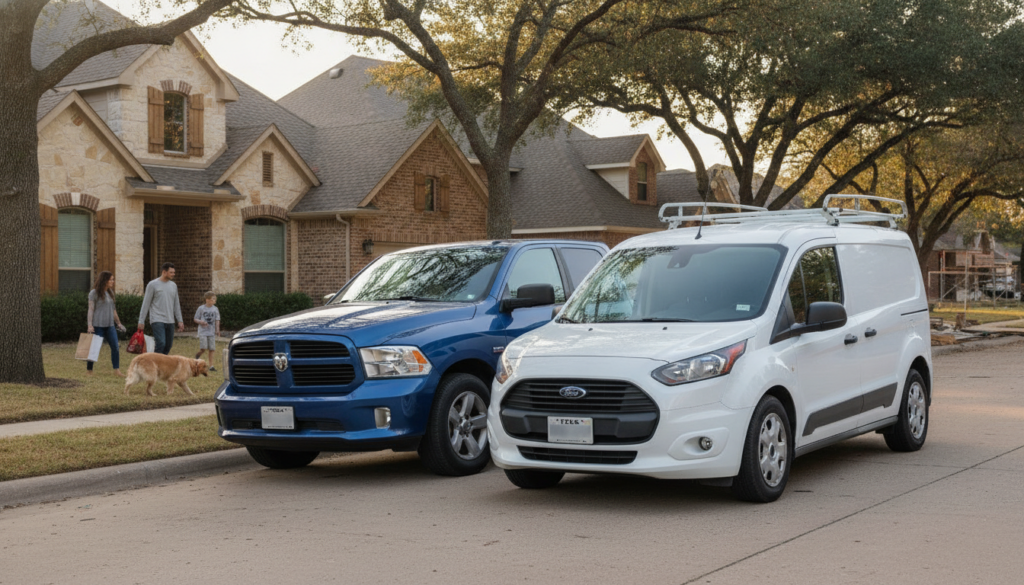
If you run a small business anywhere across Dallas-Fort Worth, odds are a vehicle is part of how you earn a living. Maybe you are a contractor loading tools into a service van before sunrise. Maybe you cater and run food across the Metroplex, tow a landscaping trailer, or log miles between client meetings from Fort Worth to Frisco. Vehicles keep DFW businesses moving. They also carry real risk every day.
One of the most common questions we get at DRH Insurance goes something like this: “I already have a personal auto policy, so I am covered for work driving too, right?” It is a reasonable assumption. The answer is usually no. Personal auto insurance is built for personal use, and running a personal vehicle through steady business activity can leave real gaps. That is why understanding the commercial auto insurance requirements Dallas business owners face matters before something goes wrong on the road.
This guide covers when a personal policy stops being enough, what Texas actually requires, and how to keep your vehicles protected through every busy season the Metroplex throws at you. This is educational information to help you ask better questions. It is not a pitch. When you are ready to talk specifics, a local agent can help you sort through your options.
Why a Personal Auto Policy Often Is Not Enough for Business Use
Personal auto insurance is built around a simple assumption. You use your vehicle for commuting, errands, road trips, and general personal driving. That describes the everyday life of most drivers. The problem starts when a vehicle becomes a working tool instead of a personal one.
Most personal auto policies contain language that limits or excludes coverage for business activities. If you are delivering products, hauling equipment for pay, transporting clients, or otherwise using the vehicle as a core part of your operation, a claim tied to that activity can be denied. A denied claim is not a minor inconvenience. It can mean paying out of pocket for repairs, medical bills, property damage, and legal costs, all at once.
Here is a hypothetical that reflects the kinds of situations we see. Treat it as a composite of DFW small businesses, not a specific real client. Picture a handyman who runs a solo operation and drives his personal pickup to jobs all over Tarrant County. He carries a personal auto policy because that is what he has always had. One afternoon, driving to a job with a bed full of tools and materials, he causes an accident. When he files the claim, the insurer reviews the circumstances, decides the vehicle was being used mainly for business, and declines the claim under a business-use exclusion. Now he is facing repair costs and a liability claim from the other driver with no coverage behind him.
That scenario gets at why the commercial auto insurance requirements Dallas businesses need to understand exist in the first place. Commercial auto insurance is built specifically for vehicles used in business. It generally offers higher liability limits and covers a wider set of risks, including multiple drivers and multiple vehicles tied to one business. When your livelihood depends on getting from point A to point B safely, that wider design matters.
Personal vs. Commercial: the core differences
Every policy is different, and the details are always worth reviewing with an agent. Still, a few general distinctions tend to hold true:
- Intended use. Personal policies assume personal driving. Commercial policies assume business driving, which usually means more miles, more stops, and higher exposure.
- Liability limits. Commercial auto policies commonly carry higher liability limits than personal ones, which reflects the larger financial risk a business can face after an accident.
- Who is covered. Commercial policies are built to cover employees and multiple drivers using business vehicles. Personal policies are not.
- What is covered. Commercial coverage can address specialized vehicles, attached equipment, and cargo in ways a personal policy generally will not.
The point is not that one is better than the other. They are built for different jobs. Stretching a personal policy over business operations is where owners get into trouble.
Commercial Auto Insurance Requirements Dallas Business Owners Should Know
So how do you know if your situation has crossed from personal into business territory? In Texas, a vehicle generally needs commercial auto insurance if any of the following apply. As you read, think about how you actually use your vehicles day to day.
1. The vehicle is used primarily for business
If a vehicle spends more than half its time on business, that is a strong signal it needs commercial coverage. A work truck that drives between job sites most of the week is a business vehicle in practice, even if you run the occasional personal errand in it.
2. The vehicle is titled in the business name
If a vehicle is owned by and titled to your business, such as an LLC, corporation, or partnership, a personal auto policy is generally the wrong fit. Ownership in the business name is one of the clearest triggers for the commercial auto insurance requirements Dallas companies run into, because the vehicle is legally a business asset.
3. You transport goods or people for a fee
Delivery services, hauling equipment or tools for pay, and transporting people all typically require commercial coverage. If money changes hands because of what your vehicle is carrying or who it is carrying, an insurer sees that as business use.
4. Employees drive for work
If employees drive for work tasks, commercial coverage often comes into play, even when they use their own personal vehicles. This is where a coverage feature called a hired and non-owned auto endorsement can matter. It is designed for situations where workers drive vehicles the business does not own but uses for business purposes. Understanding this piece is a big part of the commercial auto insurance requirements Dallas employers should think through as their teams grow.
5. You operate specialized or heavy vehicles
Vehicles built for heavy hauling, those carrying attached equipment like a service van setup or a dump truck, and vehicles over personal policy weight thresholds generally fall outside what a personal policy will handle. If your vehicle looks and works like a piece of equipment, it usually needs commercial coverage.
6. Clients or job sites demand higher liability limits
This one catches a lot of DFW contractors off guard. Many clients, general contractors, and commercial job sites require proof of higher commercial auto liability limits before allowing any work to begin. Those figures far exceed typical personal policy limits, so a personal auto policy simply will not satisfy the contract. If you want to bid on larger jobs across the Metroplex, meeting the commercial auto insurance requirements Dallas project owners set can be the difference between winning the work and getting turned away.
A quick gut check: if you would be embarrassed to explain to a claims adjuster why you were driving that vehicle, it is probably business use. When in doubt, have the conversation.
None of these triggers is meant to scare you. They exist because business driving genuinely carries more exposure than personal driving. Knowing where you stand lets you make an informed choice instead of finding a gap after an accident.
Texas Minimum Requirements and When You May Need More
Texas law sets minimum liability coverage for all vehicles, commercial ones included. That minimum is written as 30/60/25, which breaks down like this:
- Bodily injury per person
- Bodily injury per accident
- Property damage per accident
Those are the floor, not the ceiling. For many DFW businesses, especially those running heavier vehicles or carrying more risk, the minimums can fall well short of what the situation actually demands. The state minimum is a legal starting point, not a recommendation for how much protection your business needs.
Requirements can scale up sharply depending on the vehicle and what it does. Vehicles over 26,000 pounds, those hauling hazardous materials, and those carrying many passengers can face far higher requirements. Depending on weight, cargo, and passenger capacity, required limits can climb into the hundreds of thousands or even the millions. If your operation involves any of those factors, the commercial auto insurance requirements Dallas regulators and federal rules apply can look very different from a standard work van.
There is also Personal Injury Protection, or PIP, which Texas policies include. PIP can help with medical expenses and certain other costs after an accident regardless of fault, though you can decline it in writing. Whether it makes sense to keep or decline is one of many choices worth walking through with an agent who understands your operation.
Why higher limits come up so often in DFW
Dallas-Fort Worth is one of the busiest metro areas in the country. Heavy traffic corridors, constant construction, and a large, active commercial economy. More vehicles and more miles mean more chances for accidents, and accidents involving business vehicles can produce large claims. A collision involving a loaded work truck on a crowded highway can generate medical and property damage costs that quickly blow past state minimum limits.
That is exactly why so many general contractors and property owners in the region insist on higher liability limits before work starts. They know a minimum-limits policy may not cover a serious incident, and they do not want to be left exposed. Meeting the commercial auto insurance requirements Dallas job sites impose is often less about the law and more about the contracts that keep your business running.
We are not going to tell you which limits to carry. That depends on your business, your contracts, your vehicles, and your comfort with risk. What we can do is help you understand what those numbers mean and lay out the options so you can decide with clear eyes.
Matching Coverage to How DFW Businesses Actually Operate
Every business uses vehicles a little differently, and the right coverage conversation starts with understanding your specific operation. Here is how the commercial auto insurance requirements Dallas businesses face tend to show up across a few common industries in the Metroplex.
Contractors and trades
Plumbers, electricians, HVAC techs, roofers, and general contractors usually drive trucks and vans loaded with expensive tools and materials. These vehicles often carry attached equipment, tow trailers, and travel to job sites where higher liability limits are required by contract. For these businesses, commercial auto coverage frequently needs to account for the vehicle, the equipment, and the liability of driving heavy loads through busy areas.
Delivery and courier services
If your business delivers goods, whether food, flowers, packages, or products, you are transporting items and often people for a fee. That is a clear commercial use. Delivery drivers cover a lot of ground and make frequent stops, which raises exposure. This is a category where personal policies almost always fall short and commercial coverage becomes essential.
Sales and service professionals
A real estate agent, medical sales rep, or field service tech who drives their own vehicle between appointments all day sits in a gray area many people misjudge. If that driving is a core part of the job, it may count as business use even in a personal vehicle. This is where options like hired and non-owned auto coverage become worth understanding, and it is a common part of the commercial auto insurance requirements Dallas professionals overlook.
Businesses with employees behind the wheel
The moment you have employees driving, whether in company vehicles or their own cars for work errands, your risk profile changes. A business can be held responsible for what happens when an employee is driving on the clock. Commercial coverage is built to address multiple drivers and that kind of shared exposure in ways personal policies are not.
Multi-vehicle fleets
As a business grows from one truck to several, managing coverage vehicle by vehicle gets complicated. Commercial auto policies can cover multiple vehicles and drivers under one coordinated structure. That is simpler to manage and better suited to how a growing business actually runs.
The point of these examples is not to slot you into a box. It is to show that the commercial auto insurance requirements Dallas businesses face depend heavily on the details of your work. A quick, honest conversation about how you use your vehicles usually reveals exactly what needs attention.
Protecting Your Vehicles Through Every DFW Season
Business driving in Dallas-Fort Worth does not slow down, but the risks shift through the year. Continuous, adequate coverage matters in every season, and thinking about how your operation changes across the calendar can help you spot gaps before they cost you.
Winter and the holiday rush
The holiday stretch brings a surge in deliveries, retail activity, and general traffic across the Metroplex. Delivery services and any business that ramps up over the holidays put more miles on their vehicles and often add temporary drivers. DFW also sees occasional ice events that can turn familiar roads treacherous in a matter of hours. More driving in tougher conditions is exactly when you want to be confident your coverage is in place and adequate.
Spring and storm season
Spring in North Texas means severe weather, from hail to high winds. Vehicles parked at job sites or out on the road can take damage, and storm repairs create a spike in demand for contractors, which means more driving. If your business gets busier after a storm rolls through, this is a season when your vehicles work overtime.
Summer construction and peak activity
Summer is prime time for construction, landscaping, home services, and outdoor work across DFW. This is when contractors are hauling the most, job sites are most active, and those higher liability requirements come up constantly. It is also a heavy travel season with more vehicles on the road. Making sure your coverage matches your peak workload is worth doing before the busy stretch, not during it.
Fall and business growth
Many businesses reassess and expand in the fall, adding vehicles, hiring drivers, or taking on new contracts. Each of those changes can affect the commercial auto insurance requirements Dallas businesses need to meet. A vehicle added in September without updating coverage is a gap waiting to happen.
The case for annual reviews
Business operations change, sometimes faster than owners realize. You add a truck, hire a driver, land a bigger contract, or start offering delivery. Any of those shifts can change what coverage you need. An annual policy review is one of the simplest ways to make sure your coverage still fits your business and to catch gaps before they turn into denied claims. Our team encourages every business owner to treat coverage as something that grows alongside the company, not a set-it-and-forget-it decision made once and never revisited.
Common Mistakes DFW Business Owners Make With Vehicle Coverage
Over the years, our team has seen the same avoidable missteps come up again and again. Spotting them ahead of time can save you a serious headache.
- Assuming a personal policy covers business use. This is the single most common and most costly mistake. If a vehicle is used for business, do not assume your personal policy has you covered.
- Ignoring employee driving. Owners often forget that having employees drive, even in their own cars, creates exposure the business may be on the hook for.
- Carrying only state minimum limits. The 30/60/25 minimum is a legal floor. For a business, a serious accident can easily exceed it, and many contracts require far more.
- Failing to update coverage after growth. Adding vehicles or drivers without updating the policy leaves new exposures uninsured.
- Overlooking contract requirements. Finding out mid-bid that you cannot meet a client’s liability requirement can cost you the job. Knowing the commercial auto insurance requirements Dallas project owners typically expect keeps you ready to compete.
- Waiting until after an incident to ask questions. The best time to sort out coverage is before you need it. Once a claim is filed, your options are limited to whatever protection was already in place.
Most of these mistakes come from a reasonable place. Owners are busy running their businesses, and insurance is easy to put off. That is exactly why having a local agent who understands DFW operations can take the guesswork out of it. The goal is not to sell you more than you need. It is to make sure what you have actually matches how you work.
How to Think Through Your Commercial Auto Coverage
If you are trying to figure out where your business stands, a few practical questions can point you in the right direction. Ask yourself:
- Are any of my vehicles titled in the business name?
- Do I use a vehicle more than half the time for work?
- Do I transport goods, equipment, or people for a fee?
- Do employees drive for the business, in company vehicles or their own?
- Do any of my clients or job sites require proof of higher liability limits?
- Do I operate heavy vehicles, specialized equipment, or tow trailers?
- Has my business added vehicles, drivers, or new services in the past year?
If you answered yes to even one of these, it is worth a closer look at how the commercial auto insurance requirements Dallas businesses face apply to you. These questions are not a substitute for a real coverage review, but they make a useful starting point for a conversation.
Every business is different, and there is no single right answer that fits everyone. The best approach is to look at your actual operation, understand your risks, and match your coverage to how you really use your vehicles. That is a decision to make with good information and a trusted advisor, not a guess.
At DRH Insurance Group, we work with families and small businesses right here in the Dallas-Fort Worth area, and we understand how local businesses run through every season. If you have questions about whether your vehicles are properly covered, or you just want to walk through your options without any pressure, our team is glad to help you think it through. Reach out whenever you are ready, and we will help you figure out what makes sense for your business.
Frequently asked questions
Do I need commercial auto insurance in Dallas if I use my personal truck for work?
If you use a vehicle more than half the time for business, transport goods for a fee, or drive it as a core part of your job, you likely need commercial auto coverage rather than a personal policy. Personal auto policies often exclude business use, which can lead to a denied claim after an accident. It is worth reviewing your specific situation with a local agent.
What are the minimum commercial auto insurance requirements in Texas?
Texas requires minimum liability coverage written as 30/60/25 for vehicles, which covers bodily injury per person, bodily injury per accident, and property damage per accident. These are legal minimums. Many DFW businesses, especially those with heavier vehicles or contract requirements, may need significantly higher limits. Requirements can scale up based on vehicle weight, cargo, and passenger capacity.
Does commercial auto insurance cover employees who drive their own cars for work?
When employees drive for work, even in their own personal vehicles, your business may need coverage such as a hired and non-owned auto endorsement. This is designed for situations where workers drive vehicles the business does not own but uses for business purposes. A local agent can explain how this option might fit your operation.
Why do DFW contractors often need higher commercial auto liability limits?
Many clients, general contractors, and job sites require proof of higher liability limits before allowing work to begin. Those figures far exceed typical personal policy limits, so a personal auto policy will not satisfy the contract. Meeting these requirements is often necessary to bid on and win larger jobs across the Metroplex.
How often should a DFW small business review its commercial auto coverage?
An annual review is a good practice, and you should also revisit your coverage any time your operation changes. Adding a vehicle, hiring a driver, landing a bigger contract, or starting delivery services can all change what coverage you need. Regular reviews help you avoid gaps that could lead to denied claims.
Sources
- Commercial Auto vs. Personal Auto Insurance | Insureon
- How to insure commercial vehicles in Texas: a complete guide
- Texas Commercial Auto Insurance Requirements – MoneyGeek.com
- Commercial Auto Insurance in Texas – GEICO
- When Do You Need Commercial Auto Insurance?
- Small Business Auto Insurance Coverage – Liberty Mutual